About Bothriechis nigroviridis Peters, 1859
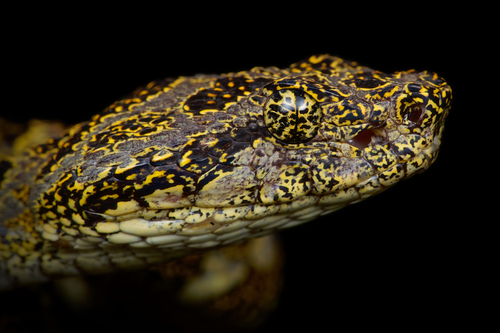
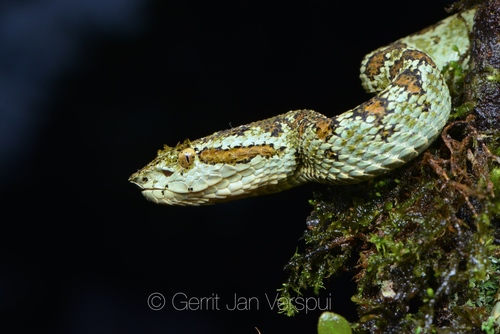
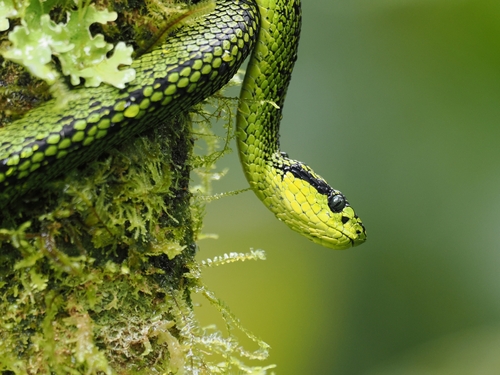
Adults of this species can grow longer than 80 centimeters (31 inches), though most adults are less than 60 centimeters (24 inches) long. Individuals are relatively slender, with a prehensile tail. Hammack and Antonio (1991) recorded two exceptionally large females measuring 89.2 centimeters (35.1 inches) and 93.7 centimeters (36.9 inches) respectively. The typical color pattern features an emerald green (rarely yellowish green) base color with prominent black mottling. Pale green dorsal blotches with black edges may also be present. The belly is yellowish green with light black mottling. The top of the head is heavily mottled with black, and often has black parietal stripes. A clearly defined postocular stripe also extends backward toward the angle of the jaw. The iris is heavily stippled, giving it an almost black appearance, and the tongue is also black. Juveniles have a similar color pattern to adults, but their coloration is paler, and the tip of their tail is black. This species is found in the mountains of Costa Rica and Panama. It also occurs in the cloud forests of the Cordillera Central and Cordillera de Talamanca, at altitudes between 1,150 and 2,400 meters. The designated type locality is "Vulcan von Barbo", which corresponds to Volcán Barba, Costa Rica. Campbell and Lamar (2004) note this species prefers medium to high elevations ranging from 1,150 meters to over 3,000 meters. Its distribution extends from Cordillera Tilarán and Cordillera Central in southeastern Alajuela Province, Costa Rica, southeast through the Cordillera de Talamanca to Chiriquí Province, Panama. It can be found on both the Atlantic and Pacific slopes. This species inhabits high montane forest, lower montane wet forest, and cloud forest. It has a limited range and is generally considered relatively rare, although it is locally common in undisturbed habitat. Picado (1931) observed that this species quickly disappears from cultivated areas.