About Bothriechis lateralis Peters, 1862
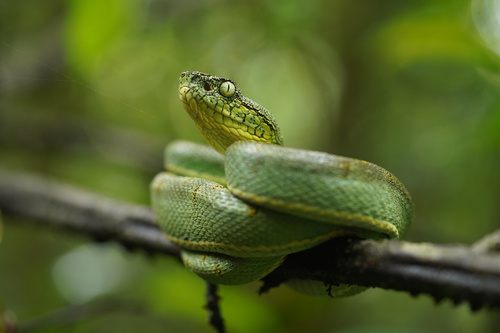
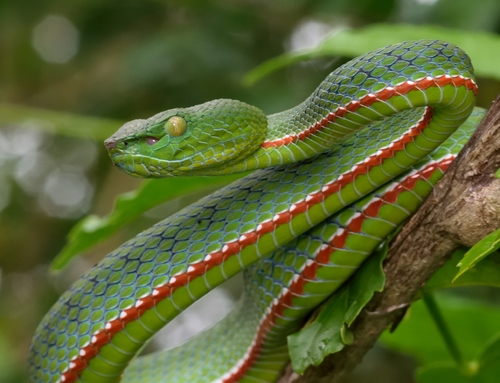
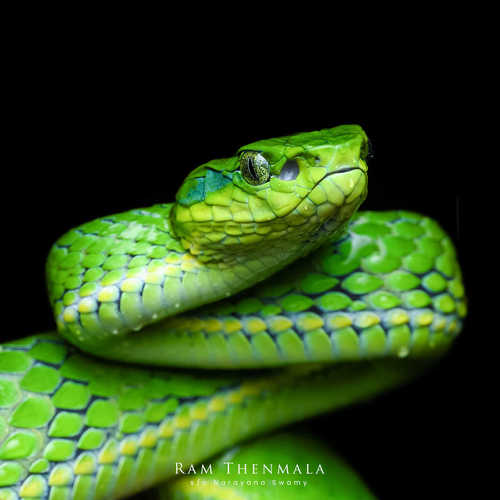
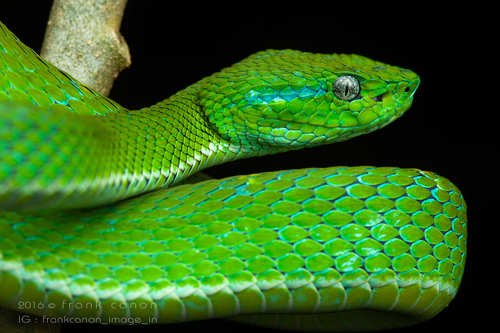
This species is Bothriechis lateralis Peters, 1862. Adult individuals usually grow to less than 80 centimetres (31 in) in length, though some specimens may exceed 100 centimetres (39 in). They are relatively slender snakes with a prehensile tail. Their base color ranges from emerald green to bluish green, marked with a series of alternating yellow paravertebral vertical bars. Some scales adjacent to these yellow markings may have blue or black tips. The belly is an even yellow-green, with a pale yellow stripe along each side that runs across the lower part of the paraventral scales and the outermost lateral section of the ventral scales. The top of the head is solid green, and a weakly defined blue or blue-gray postocular stripe may be present; this stripe is especially faint in large adults. Adult individuals have yellow irises. Juvenile specimens are typically brown, with dark brown markings on the head, bronze irises, postocular stripes, yellow-edged paravertebral markings, and a yellow or chartreuse tail tip. Captive juveniles keep this juvenile color pattern for around six months, after which their base color begins to change to a dull lime green, and the yellow edges of the paravertebral vertical bars become more noticeable. It is estimated that the full transition to adult coloration takes 18 to 24 months to complete. Like many green snake species, captive adult Bothriechis lateralis tend to turn blue over time, though blue individuals are sometimes also found in wild populations. This species is geographically distributed in the mountains of Costa Rica and western Panama, including the Cordillera de Tilarán, the Cordillera Central, and the Cordillera de Talamanca, extending into Panama's Chiriquí Province and Veraguas Province. It occurs at altitudes between 850 and 980 meters. The listed type locality is "Costa Rica vom Vulcan Barbo [Volcán Barba] ... und .. Veragua" [Panama]. It inhabits lower montane forest, lower montane wet forest, and lower montane rainforest. While this species can survive in some areas modified for agricultural use, such as coffee plantations, it is gradually disappearing from these altered habitats. In contrast, it is common in many protected areas, where its populations are considered stable and healthy.