About Bothriechis aurifer (Salvin, 1860)
Adults of Bothriechis aurifer generally reach a total length of less than 70 centimetres (28 inches), though some individuals grow to over 1 metre (3 feet 3 inches). This species has a relatively slender body and a prehensile tail. Its scalation features 1–5 intersupraocular scales, 8–12 supralabials, 9–13 inflabials, and 18–21 (most commonly 19) rows of dorsal scales at midbody. The second supralabial is fused with the prelacunal to form a lacunolabial structure, and there are 16–21 interrictal scales. Males have 148–167 ventral scales and 58–64 mostly undivided subcaudal scales, while females have 152–162 ventral scales and 48–61 subcaudal scales.
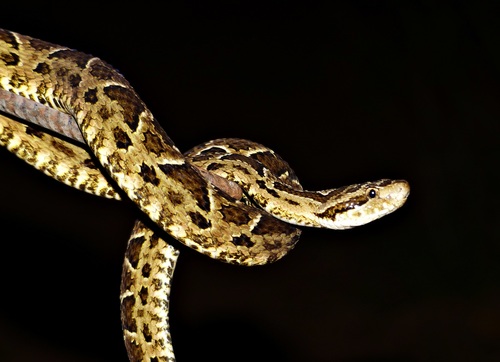
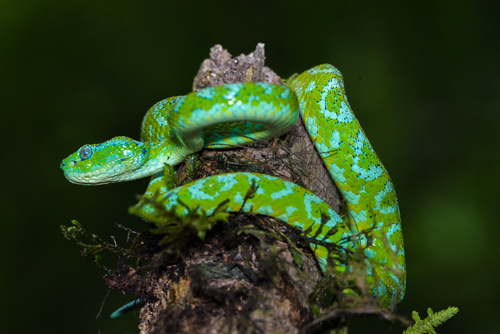
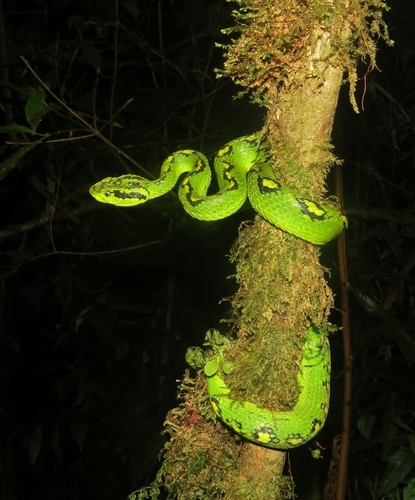
The adult color pattern is built on a green base color, with a series of black-bordered yellow blotches running along the back. An irregular, often broken dorsal stripe is visible between these blotches. The belly is yellowish green and typically lighter in color than the dorsal surface. The head has a dark postocular stripe. The iris is usually yellowish-green, sometimes bronze, marked with black specks or reticulations. Over 90% of all specimens have the typical dark dorsal pattern, but a small number are uniformly green and lack postocular stripes. Juveniles have a pale lime green ground color and a brightly colored tail tip.
This species is found in the mountains of eastern Chiapas, Mexico, and in northern Guatemala. It occurs in cloud forest at altitudes between 1200 and 2300 m. Its given type locality is "Cobán, Alta Vera Paz, Guatemala."