About Bossiaea rupicola A.Cunn. ex Benth.
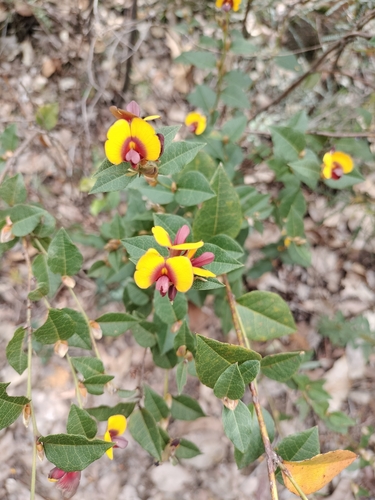
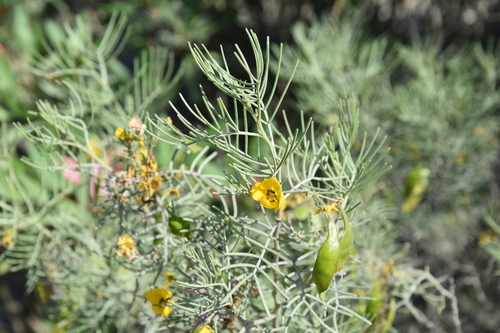
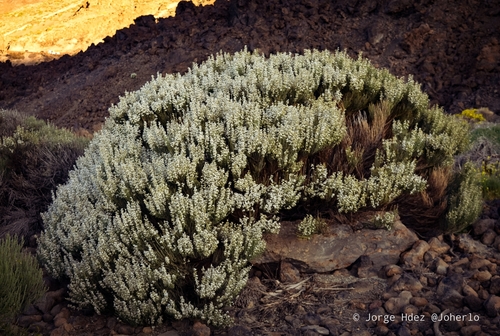
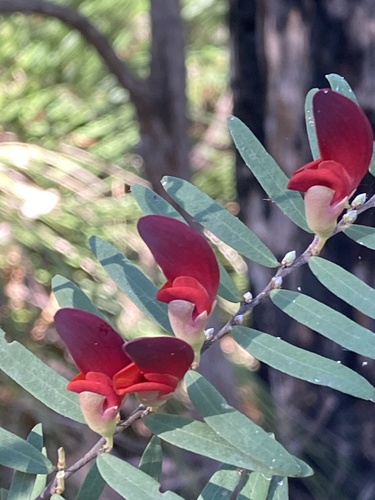
Bossiaea rupicola A.Cunn. ex Benth. is an erect shrub that typically grows 2 to 4 meters (6 feet 7 inches to 13 feet 1 inch) tall. Its young stems are covered in silky hairs, and become hairless (glabrous) as they age. Leaves are arranged in two vertical rows along the stems, and are shaped from narrow egg-shaped to narrow elliptic. Each leaf is 12 to 20 millimeters (0.47 to 0.79 inches) long and 3 to 6 millimeters (0.12 to 0.24 inches) wide, borne on a 0.5 to 1 millimeter (0.020 to 0.039 inches) long petiole, with stipules up to 1 millimeter (0.039 inches) long at the base. Both surfaces of the leaves are covered in silky hairs pressed against the leaf surface, becoming glabrous with age. The flowers are roughly 20 millimeters (0.79 inches) long, growing on 3 to 5 millimeter (0.12 to 0.20 inch) long pedicels. There are a few small bracts less than 1 millimeter (0.039 inches) long at the base of the pedicel, and similar small bracteoles near the pedicel base. The five sepals are 5 to 7 millimeters (0.20 to 0.28 inches) long and are joined at the base to form a tube. The upper sepals lobes are 2.5 to 4 millimeters (0.098 to 0.157 inches) long and 3 millimeters (0.12 inches) wide, while the lower lobes are shorter and narrower. The standard petal is yellow with a red back, and grows up to 10 millimeters (0.39 inches) long. The wing petals are 4 to 5 millimeters (0.16 to 0.20 inches) wide, and the keel is red and 5 to 8 millimeters (0.20 to 0.31 inches) longer than the standard. Flowering takes place from late winter to spring, and the fruit is an oblong to nearly oblong pod 15 to 40 millimeters (0.59 to 1.57 inches) long. This pea species grows in open forest, woodland, and heathland, often growing between rocks. It occurs mostly on the McPherson Range near the New South Wales-Queensland border, and is also found in Kroombit Tops National Park and near Biloela and Biggenden further north in Queensland.