About Bossiaea obcordata (Vent.) Druce
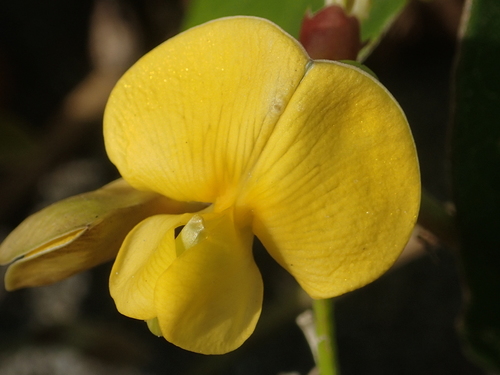
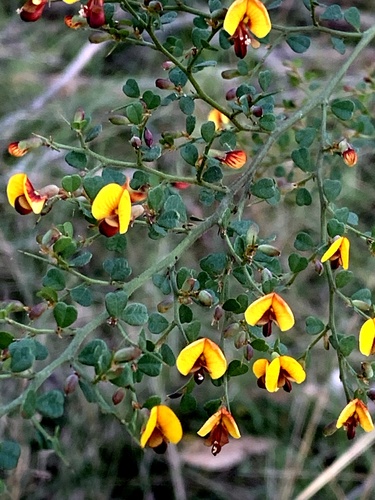
Bossiaea obcordata (Vent.) Druce is an erect, rigid shrub that typically grows up to 1.5 meters (4 feet 11 inches) tall. It has flattened branchlets that develop spines as they age. Its leaves are arranged alternately along the stems; they are broadly egg-shaped to heart-shaped with the narrower end at the base, and sometimes nearly round. Leaves are 30–60 mm (1.2–2.4 in) long and wide, borne on a petiole 0.5–1.5 mm (0.020–0.059 in) long, with narrow triangular stipules 1–2 mm (0.039–0.079 in) long at the leaf base. The flowers are mostly 8–10 mm (0.31–0.39 in) long, arranged singly along the branches, with each flower growing on a pedicel up to 5 mm (0.20 in) long. Sepals are 3–5 mm (0.12–0.20 in) long, and there are bracteoles up to 2 mm (0.079 in) long attached to the pedicel. The standard petal is yellow with a red base and grows up to 10 mm (0.39 in) long. The wing petals are usually purplish-brown and about 2.5 mm (0.098 in) wide, while the keel petal is pinkish to red and 3–4 mm (0.12–0.16 in) wide. Flowering occurs between September and October, and the fruit is a narrow oblong pod 15–20 mm (0.59–0.79 in) long. This species grows in forest and heath habitats, most often on dry sandstone ridges and slopes. Its range extends from far southeastern Queensland, through the coast, western slopes and tablelands of eastern New South Wales, to central and eastern Victoria. Specimens previously recorded from Tasmania are now classified as the separate species Bossiaea tasmanica.