About Bossiaea buxifolia A.Cunn.
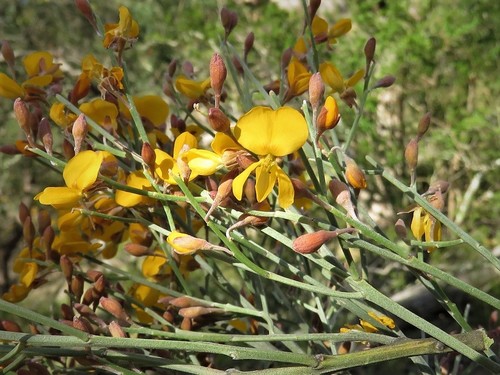
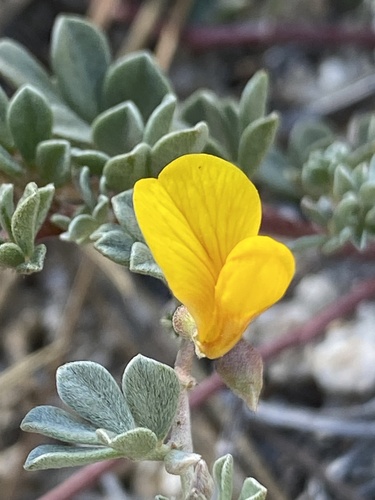
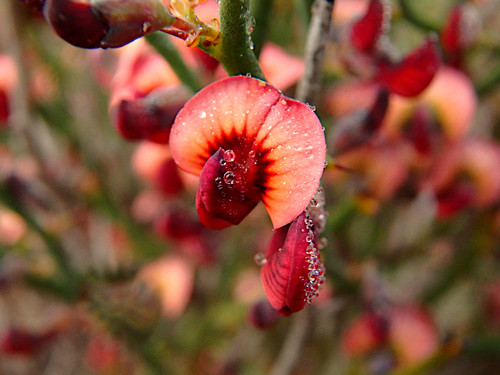
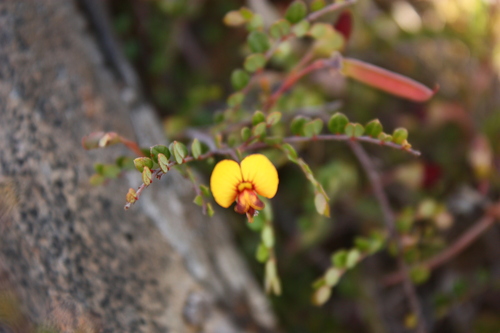
Bossiaea buxifolia, commonly known as matted bossiaea, is a prostrate to weakly erect shrub. It typically grows up to 50 cm (20 in) tall, and may occasionally reach heights of 1.3 m (4 ft 3 in). Its stems are covered in soft hairs. Leaves are arranged alternately, and are elliptic, egg-shaped, or roughly round in shape. Most leaves are 2.5–5.0 mm (0.098–0.197 in) long and 2–5 mm (0.079–0.197 in) wide, borne on a 0.2–0.5 mm (0.0079–0.0197 in) long petiole. Narrow triangular stipules 1–2 mm (0.039–0.079 in) long are present at the base of each leaf. Flowers are usually borne on short side branches. Each flower is 6–10 mm (0.24–0.39 in) long, growing on a 6–10 mm (0.24–0.39 in) long pedicel, with a few small bracts and 1–2 mm (0.039–0.079 in) long bracteoles at the base. The sepals are 3–6 mm (0.12–0.24 in) long and joined at the base. The upper sepal lobes are 1.5–2.5 mm (0.059–0.098 in) long, and the lower sepal lobes are slightly shorter. The standard petal is yellow with a red base, darker in color on its back, and grows up to 9 mm (0.35 in) long. The wing petals are yellow and orange, and slightly shorter than the standard. The keel petal is dark red to purplish, and less than 6 mm (0.24 in) long. Flowering takes place from spring to early summer. The fruit is a narrow oblong pod 15–30 mm (0.59–1.18 in) long. This species grows in forest and woodland. It occurs south from Kroombit Tops National Park in south-eastern Queensland, along the coast and tablelands of eastern New South Wales and the Australian Capital Territory, to the ranges east of Omeo in eastern Victoria.