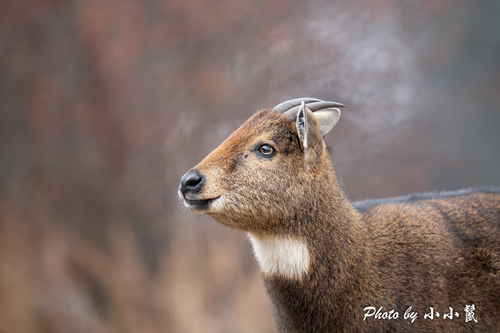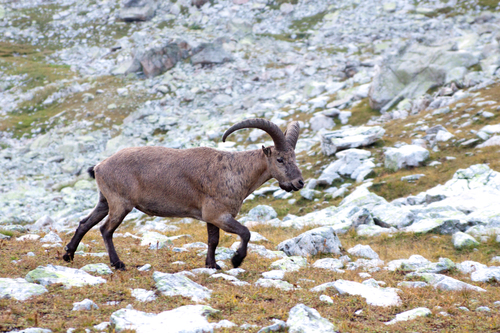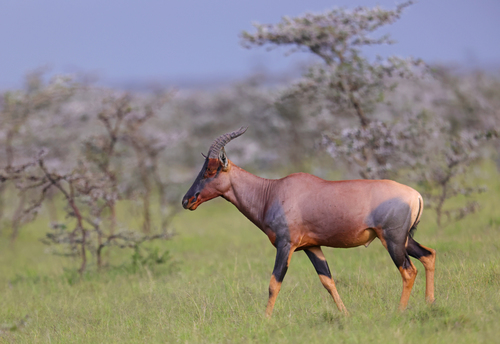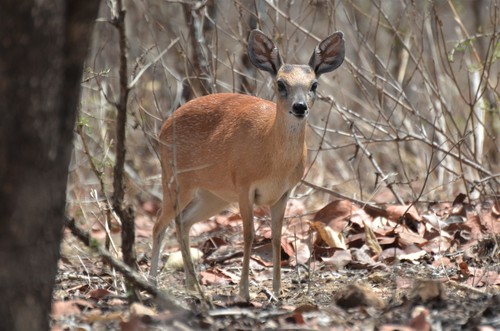
About Boselaphus tragocamelus (Pallas, 1766)
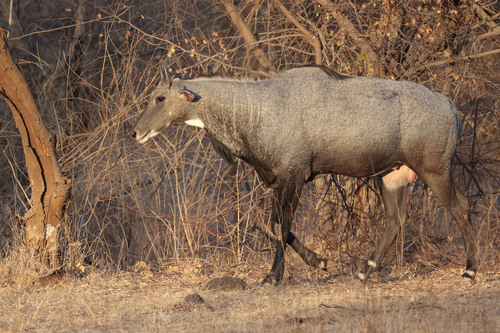
The nilgai (Boselaphus tragocamelus) has a sturdy build with a deep neck, sloping back, and thin legs. It has a short mane that runs behind along the back, ending behind the shoulder, a white throat patch, and roughly two white spots each on its face, ears, cheeks, lips, and chin. Black-tipped ears measure 15–18 cm (5.9–7.1 in) long. Below the white throat patch along the dewlap ridge, there is a column of coarse hair called the "pendant", which is around 13 cm (5.1 in) long in males. The tufted tail has a few white spots, is tipped with black, and reaches up to 54 cm (21 in) long. Forelegs are generally longer than hindlegs, and often marked with white "socks". Females and juveniles are orange to tawny, while mature males are much darker, typically bluish-grey. Ventral areas, the insides of the thighs, and the tail are all white. A white stripe extends from the underbelly and broadens near the rump, forming a patch lined with dark hair. Almost white (non-albino) individuals have been recorded in Sariska National Park, and individuals with white patches have been noted in zoos. Hairs are typically 23–28 cm (9.1–11.0 in) long, fragile and brittle. Males have thicker skin on their head and neck to protect them during fights. Nilgai do not have good subcutaneous fat insulation in winter, so severe cold can be fatal. Most males have horns, and occasionally females do as well. Horns are 15–24 cm (5.9–9.4 in) long, generally shorter than 30 cm (12 in), smooth and straight, and may point either backward or forward. They lack the ringed structure typical of other bovids' horns. The nilgai is the largest antelope in Asia. It stands 1.0–1.5 m (3 ft 3 in – 4 ft 11 in) at the shoulder, with a typical head-and-body length of 1.7–2.1 m (5 ft 7 in – 6 ft 11 in). Males weigh 109–288 kg (240–635 lb), with a maximum recorded weight of 308 kg (679 lb). Females are lighter, weighing 100–213 kg (220–470 lb). Sexual dimorphism is prominent: males are larger than females and differ in colouration. The maximum recorded skull length is 376 mm (14.8 in). The dental formula is 0.0.3.3 / 3.1.3.3. All milk teeth are lost and permanent dentition is fully developed by three years of age. Permanent teeth wear down with age, showing prominent wear by six years. The nilgai has keen vision and hearing, but its sense of smell is not acute. The nilgai is endemic to the Indian subcontinent, with major populations in India, Nepal, and border areas of Pakistan. Large populations are found in the Terai lowlands in the Himalayan foothills, and it is abundant across northern India. It prefers areas with short bushes and scattered trees in scrub forests and grassy plains, and is common in agricultural lands, but rarely occurs in dense woods. In southern Texas, it inhabits prairies, scrub forests, and oak forests. It is a generalist animal that can adapt to a variety of habitats. Though it is sedentary and less dependent on water, nilgai will leave their territories if all local water sources dry up. Territories in Texas measure 0.6 to 8.1 km2 (0.23 to 3.13 sq mi) in area. The Indian population was estimated at one million in 2001. The nilgai was thought to be extinct in Bangladesh, but some individuals from India and Nepal have recently crossed into the country's northwest. Nilgai were first introduced to Texas in 1924 by Caesar Kleberg, onto a 6,000-acre (2,400 ha) ranch near the Norias Division of the King Ranch, one of the world's largest ranches. The feral population grew rapidly in the late 1940s, and gradually spread to adjacent ranches. Population density varies widely across India: it can be as low as 0.23 to 0.34 individuals per km2 in Indravati National Park and 0.4 per km2 in Pench Tiger Reserve, and as high as 6.6 to 11.36 per km2 in Ranthambhore National Park and 7.0 individuals per km2 in Keoladeo National Park. A 1980 study in Bardiya National Park noted seasonal variation: density was 3.2 per km2 in the dry season and 5 per km2 in April at the start of the dry season. In southern Texas, densities were measured at 3–5 per km2 in 1976. Historical records mention nilgai in southern India, but these may have been feral populations descended from escaped semi-domesticated herds once kept by native rulers. The nilgai is diurnal, active mainly during the day. A 1991 study of the antelope's daily routine found feeding peaks at dawn, in the morning, in the afternoon, and during the evening. Females and juveniles do not interact significantly with males except during the mating season. Groups are generally small, with 10 or fewer individuals, though groups of 20 to 70 individuals can sometimes form. A 1980 study in Bardiya National Park found an average herd size of three individuals, while a 1995 study in Gir National Park found herd membership varies by season. Three distinct group types are formed: one or two females with young calves, three to six adult and yearling females with calves, and male groups with two to 18 members. Typically calm, nilgai may become timid and cautious when harassed or alarmed; instead of seeking cover like duikers, they will flee 300 metres (980 ft) – or even 700 metres (2,300 ft) when galloping – away from danger. Though generally quiet, nilgai have been reported to make short guttural grunts when alarmed, and females make clicking noises while nursing young. Alarmed individuals, mostly juveniles under five months old, produce a coughing roar that lasts half a second, has the highest pitch in juveniles, can be heard by herds less than 500 m (1,600 ft) away, and elicits responses from the herd. Fights occur in both sexes, and involve pushing necks against each other or ramming with horns. Fights can be gory; despite protective thick skin, deep lacerated wounds and even death can occur. Display behaviour centers on the throat patch and beard, and threatening opponents by pointing horns toward them. A young male was observed performing a submissive display in the Sariska Reserve by kneeling before an erect adult male. Nilgai mark their territories by creating dung piles up to 50 cm (20 in) in radius. Their defecation process is elaborate: the antelope stands with legs roughly 1 m apart, rump lowered, tail held almost vertical, and stays in this posture for at least 10 seconds after defecating. The process is less elaborate in females than in males. In India, the nilgai shares its habitat with the four-horned antelope, chinkara, chital, and blackbuck; it associates less commonly with gaur and water buffalo. In Ranthambore National Park, nilgai and chinkara collectively prefer areas rich in Acacia and Butea species, while sambar deer and chital prefer forests of Anogeissus and Grewia species. In India, Bengal tigers and Asiatic lions prey on nilgai, though Asiatic lions are not a significant predator of this antelope. Leopards also prey on nilgai, though they generally prefer smaller prey. Dholes generally attack only juvenile nilgai. Other predators include the Indian wolf and striped hyena. Observations of females in southern Texas found that ovaries develop by two years of age, and the first birth typically occurs one year later, though a few females as young as one-and-a-half years can mate successfully. Females can breed again roughly one year after giving birth. Males in the same location have active testes by age three, which mature considerably by the next year, and males become sexually active at four or five years. Mating can occur throughout the year, with 3 to 4 month long peaks that vary geographically. In Texas, the mating peak falls from December to March. In Bharatpur National Park, the breeding season runs from October to February, peaking in November and December. Sariska Reserve sees a similar peak in December and January. During the mating season, rutting males travel to search for oestrous females, become aggressive, and fight each other for dominance. These fights include displays of the enlarged chest, throat patch, and beard while holding the head upright, and threatening opponents by running toward them with horns pointed and circling. The victorious male guards the area around the chosen female from other males. Courtship typically lasts 45 minutes. A stiff, composed male approaches the receptive female, who holds her head low to the ground and may walk slowly forward. The male licks her genitalia, after which the female moves her tail to the side and the male performs a flehmen response, before the male pushes his chest against her rump and mounts her. Gestation lasts eight to nine months, after which a single calf, twins, or rarely triplets are born. A 2004 study in Sariska Reserve found twins made up as much as 80 percent of the total calf population. Births peak from June to October in Bharatpur National Park, and from April to August in southern Texas. Calves are precocial: they can stand within 40 minutes of birth, and forage on their own by the fourth week. Pregnant females isolate themselves before giving birth. As is typical for many bovid species, nilgai calves stay hidden for the first few weeks of life; this concealment period can last up to a month in Texas. Calves, mainly males, engage in playful neck-fighting. Young males leave their mothers at ten months old to join bachelor groups. The typical lifespan of the nilgai is ten years in Texas.