About Bos javanicus d'Alton, 1823
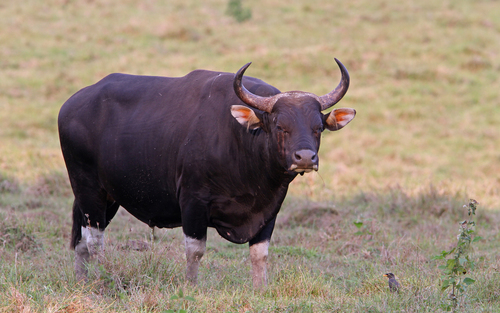
Bos javanicus, commonly known as banteng, shares similarities with taurine cattle. Their head-and-body length ranges from 1.9 to 2.25 m (6.2 to 7.4 ft). Wild banteng are typically larger and heavier than domesticated banteng, but are otherwise similar in appearance. The average shoulder height of wild Javan and Indochinese banteng is 1.4 m (4.6 ft) for females (cows) and 1.6 m (5.2 ft) for males (bulls). Bornean banteng, the smallest subspecies, are shorter than these other populations. Domesticated banteng cows reach 1.2 m (3.9 ft) at the shoulder, while domesticated bulls stand 1.3–1.5 m (4.3–4.9 ft) tall. In the wild, cows weigh approximately 590–670 kg (1,300–1,480 lb), and bulls weigh 600–800 kg (1,300–1,800 lb). Domesticated banteng weigh between 211 and 242 kg (465 and 534 lb) for females, and 335 to 363 kg (739 to 800 lb) for males. The largest bulls can reach 3.3 to 3.7 m (11 to 12 ft) from nose to rump, have tails 0.9 to 0.95 m (3.0 to 3.1 ft) long, stand 1.76 to 1.91 m (5.8 to 6.3 ft) at the withers, and weigh 900 kg (2,000 lb) or more. Banteng exhibit extensive sexual dimorphism. Adult bulls are generally dark brown to black, larger and more sturdily built than adult cows, which are slimmer and usually pale brown or chestnut red. Females and juveniles also have a dark line running along their back. Some bulls may keep their brown colour, sometimes with white spots similar to those seen on deer. Young bulls have a reddish brown coat, which gradually develops adult colouration starting from the front and moving toward the rear. Aged bulls may turn grey. The underparts are white to light brown. The face is lighter than the rest of the body, whitish or tawny grey on the forehead and around the eyes, but darker near the black snout. There is a large white patch on the rump, which is poorly developed in Indochinese banteng; this patch is thought to help guide herds to stay together in the dark. Legs are white below the knees. Bulls have an especially elevated back due to the unusual length of their thoracic vertebrae, creating the appearance of a hump. Horns are typically 60 to 75 cm (24 to 30 in) long, and separated by thick skin at the base. Bulls have long, slender horns with sharp tips and a circular cross-section; they are smooth except for a wrinkled base. Cow horns are short and tightly curved, pointing inward at the tips, while bull horns curve upwards and slightly forward. The tail measures 65 to 70 cm (26 to 28 in) and ends in a black tuft.
Banteng live in a variety of habitats across their range, including open deciduous forests, semi-evergreen forests, lower montane forests, abandoned farms, and grasslands. They can be found up to 2,100 m (6,900 ft) above sea level. The largest wild banteng populations are in Cambodia, Java, and possibly in Borneo, Vietnam's Tay Nguyen region, and Thailand. They are also confirmed to occur in Kalimantan (Borneo) and Myanmar. Their presence is unconfirmed in Bali, Sarawak, China, and Laos, and they are thought to be extinct in Bangladesh, Brunei, and India (if they ever occurred there). Domesticated banteng are found in Bali, many eastern Indonesian islands including Sulawesi, Sumbawa, and Sumba, Australia, Malaysia, and New Guinea. Feral populations live in East Kalimantan, Australia's Northern Territory, and possibly on Enggano and Sangihe in Indonesia. Historically, banteng were widespread across the Southeast Asian mainland, including Yunnan Province (China), and extended through Peninsular Malaysia to Borneo and Java; northeastern India and Bali were probably part of their historical range. Some researchers exclude Bali from the historical range due to a lack of fossil evidence, and consider banteng an introduced species there. Cave art from East Kalimantan dating to around 10,000 BC depicts a bovid that some researchers suggest is banteng, leading to speculation that the species may have reached as far as the Wallace Line by that time. Dutch naturalist Andries Hoogerwerf notes that banteng likely existed in Java since prehistoric times, as indicated by remains dating to around 1,000 BC found in the Sampung cave in Ponorogo Regency, Central Java.
Banteng are active during both the day and night, though they are more active at night in areas that people frequent. They typically form herds of 2 to 40 individuals, made up of one bull, cows, and young. Older males form groups of two or three. Banteng are timid and reclusive, and tend to be highly alert, which makes them difficult to approach. Domestic banteng become stressed easily and require careful handling. They rest and seek safety shelter in dense forests. Banteng, especially cows and calves, walk quickly and move easily through dense cover. Predators of adult banteng include local tiger and dhole (Asian wild dog) populations. Banteng use their strong sense of smell to detect predators and to communicate with other herd members. Their hearing is also highly developed. Vocalizations such as roars and bellows are likely common during the breeding season; calves under seven months old may produce soft eng sounds. High-pitched cries are used as an alarm call.
Little is known about banteng reproductive physiology, but it is thought to be similar to that of taurine cattle. Domestic banteng can reach sexual maturity as early as 13 months of age, and breed three months after reaching maturity. They conceive easily, with a conception rate of 80–90% recorded in northern Australia. Breeding has been observed year-round in captive banteng and wild banteng in Myanmar, though wild individuals on Cobourg Peninsula mainly mate in October and November, and mating peaks in May and June in Thailand. After a gestation period of nearly 285 days (nine to ten months), which is one week longer than the typical gestation of taurine cattle, a single calf is born. Male calves weigh 16–17 kg (35–37 lb) at birth, while female calves weigh 14–15 kg (31–33 lb). Young are suckled for up to 16 months, and some cows continue nursing until the birth of their next calf. A study of wild banteng on Cobourg Peninsula found that males become sexually mature at three to four years old, and females at two to four years old. Males reach full adult size at five to six years old, while females finish growing at three to four years old. Calf mortality is high in the first six months of life, and declines quickly as body size increases. Banteng can live up to 26 years.
Banteng were domesticated on the Indonesian islands of Java or Bali around 3,500 BC. The domesticated population consists mostly of Bali cattle in Indonesia. As of 2016, Bali cattle make up nearly 25% of the Indonesian cattle population (2.45 million out of a total 9.8 million). Domesticated banteng are docile and can tolerate hot, humid weather. They can thrive and maintain normal body weight even on poor quality fodder. They are primarily raised for their popular meat, which is described as lean and soft. They are also used as draught animals to a limited extent; banteng are reportedly less efficient than zebu at dragging carts on roads, but are suitable for agricultural work. Banteng produce very little milk: they lactate for only six to ten months, and daily production is just 0.9–2.8 kg (2.0–6.2 lb). They are also vulnerable to diseases such as bovine malignant catarrhal fever. In 1964, an outbreak of an unidentified local disease called "jembrana" killed 10–60% of domesticated banteng populations across several areas of Bali; similar but less severe outbreaks have continued since that time. The disease was later determined to be caused by a lentivirus.