About Bos grunniens Linnaeus, 1766
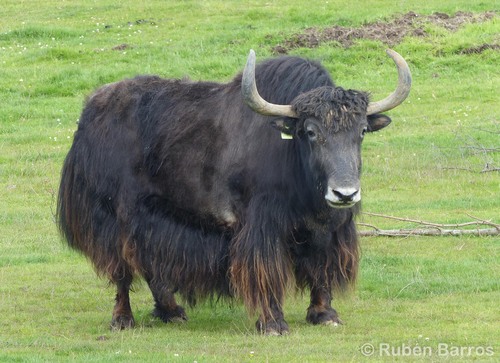
Yaks, scientifically named Bos grunniens Linnaeus, 1766, are heavily built animals with bulky frames, sturdy legs, rounded cloven hooves, and extremely dense long fur that hangs lower than the belly. Wild yaks typically have dark coloration ranging from blackish to brown, while domestic yaks have quite variable coloration, often with rusty brown and cream patches. Yaks have small ears, broad foreheads, and smooth horns that are generally dark in color. In male yaks (called bulls), horns sweep out from the sides of the head then curve backwards, and typically measure 48 to 99 cm (19 to 39 in) long. Female yaks (called cows) have smaller horns, measuring 27 to 64 cm (11 to 25 in) in length, with a more upright shape. Both sexes have a short neck with a pronounced hump over the shoulders, and this hump is larger and more visible in males. On average, males weigh 350 to 585 kg (772 to 1,290 lb), while females weigh 225 to 255 kg (496 to 562 lb). Wild (feral) yaks can be substantially heavier, with bulls reaching weights up to 1,000 kg (2,200 lb). Depending on their breed, domestic yak males stand 111–138 cm (44–54 in) high at the withers, while domestic yak females stand 105–117 cm (41–46 in) high at the withers. Both sexes have long shaggy outer hair, plus a dense woolly undercoat covering the chest, flanks, and thighs that insulates against cold. This long lower hair often forms a "skirt" that reaches the ground, especially in bulls. Yak tails are long and horselike, unlike the tufted tails of cattle or bison. Domesticated yaks have a wide range of coat colors, with some individuals being white, grey, brown, roan, or piebald. To protect against cold, the female udder and male scrotum are small and hairy, and females have four teats. Yaks do not produce the characteristic lowing (mooing) sound of cattle, but both wild and domestic yaks grunt and squeak. This grunting behavior inspired the scientific name Bos grunniens, which means "grunting bull". Nikolay Przhevalsky named the wild variant Bos mutus, meaning "silent bull", because he believed it did not make any sound at all, though wild yaks do produce sound. Yaks mate in the summer, most often between July and September, depending on the local environment. For the rest of the year, many bulls wander in small bachelor groups separate from larger herds. As the rut approaches, bulls become aggressive and regularly fight one another to establish dominance. Along with non-violent threat displays, bellowing, and scraping the ground with their horns, bull yaks compete more directly by repeatedly charging at each other with lowered heads or sparring with their horns. Unlike cattle but similar to bison, males wallow in dry soil during the rut, often while scent-marking with urine or dung. Females enter oestrus up to four times a year, and are receptive only for a few hours each cycle. Gestation lasts between 257 and 270 days, so calves are born between May and June, almost always as a single birth. The cow finds a secluded spot to give birth, but the calf can walk within about ten minutes of birth, and the pair soon rejoin the herd. Both wild and domestic females typically give birth only once every other year, though more frequent births are possible if food is abundant. Calves are weaned at one year old and become independent shortly after weaning. Wild calves are initially brown, and only develop the darker hair of adults later in life. Females generally give birth for the first time at three or four years of age, and reach their peak reproductive fitness at around six years. Yaks may live for more than twenty years in domestication or captivity, and wild yaks likely have somewhat shorter lifespans.