About Bos frontalis gaurus C.H.Smith, 1827
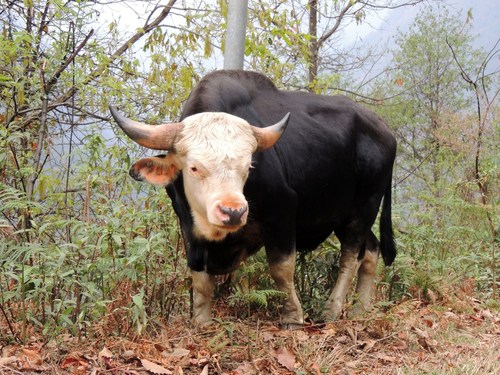
Gayal differs from gaur in several key characteristics. It is somewhat smaller, with proportionately shorter limbs, and stands much lower at the withers. Its back ridge is less developed, and bulls have a larger dewlap on the throat. The head is shorter and broader, with a completely flat forehead and a straight line between the bases of the horns. The thick, massive horns are less flattened and far less curved than those of gaur; they extend almost directly outwards from the sides of the head, curve slightly upwards at the tips, and have no inward inclination. This means the horn tips are much farther apart than in gaur. Female gayal are much smaller than bulls, and have almost no throat dewlap. Both sexes have blackish-brown skin on the head and body, with white or yellowish lower portions of the limbs. The horns are a uniform blackish tint from base to tip. Some domesticated gayal are parti-coloured, while others are fully white. Gayal are found on the southern slopes of the Eastern Himalayas in Northeast India, Bangladesh, Myanmar, Bhutan, and Yunnan, China. They inhabit elevations from 300 to 5,000 m (980 to 16,400 ft) in areas with temperatures ranging from 20 to 30 °C (68 to 86 °F). Their preferred habitat is undisturbed forested hilly terrain that contains streams, ponds, and lakes, with abundant shrubs, trees, bamboo, and coarse grasses. They are also attracted to salt lick hotspots. In India, several ethnic groups living in the forested hills of Tripura, Mizoram, Assam, Arunachal Pradesh, Manipur, and Nagaland keep semi-domesticated gayal. Gayal are also found in the Chittagong Hill Tracts, in Kachin State of northern Burma, and only in the Trung (Dulong River) and Salween River basins in adjacent Yunnan. Gayal perform an important ecological function, acting as ecosystem engineers in northeast India. They aid seed dispersal and enrich soil through their foraging activities and manure.