About Boronia safrolifera Cheel
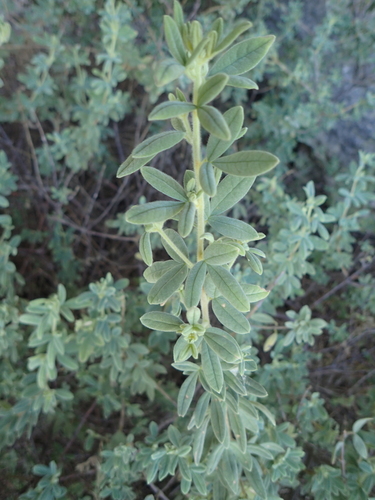
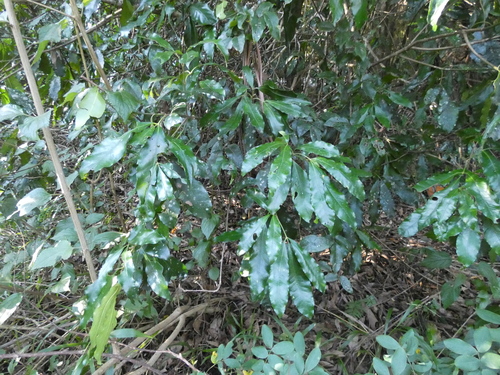
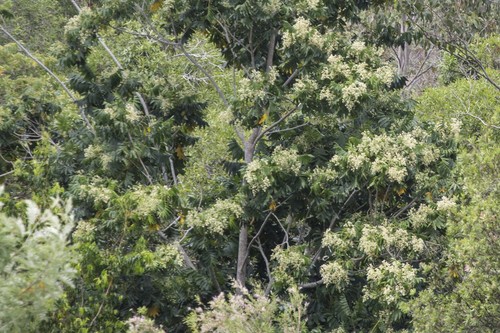
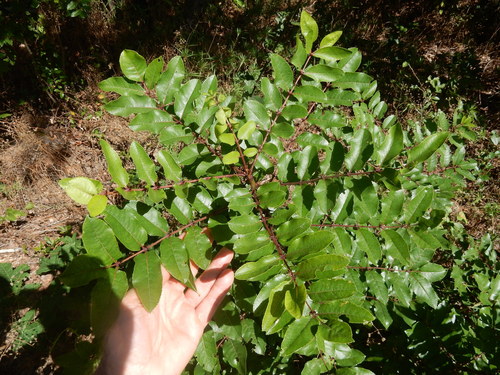
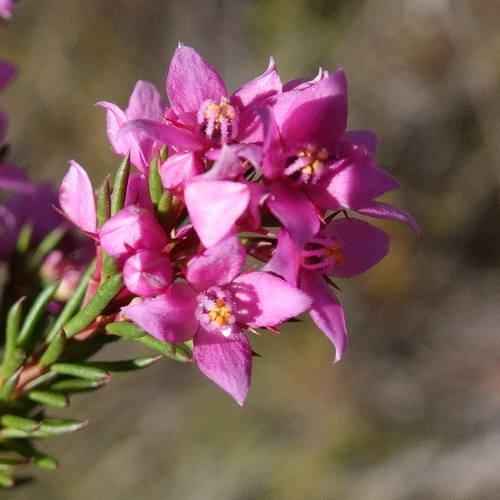
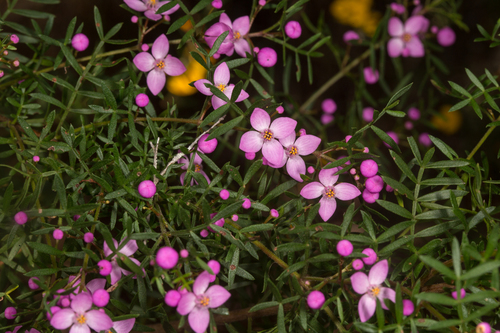
Boronia safrolifera is an erect, woody shrub that typically grows 0.5 to 2.5 meters (1 foot 8 inches to 8 feet 2 inches) tall, and its branches are mostly hairless. The leaves of this species are pinnate, with between 7 and 19 leaflets on average. The overall leaf outline measures 12 to 47 millimeters (0.47 to 1.85 inches) long and 14 to 35 millimeters (0.55 to 1.38 inches) wide, attached to a 3 to 11 millimeter (0.12 to 0.43 inch) long petiole. The end leaflet is elliptic to narrowly egg-shaped, usually 2.5 to 7 millimeters (0.098 to 0.276 inches) long and 1 to 2 millimeters (0.039 to 0.079 inches) wide. Side leaflets have a similar shape but are longer than the end leaflet. The underside of each leaflet is a paler green than the upper surface. Flowers are arranged in groups of 3 to 12, growing in leaf axils and at the ends of branchlets. Groups grow from a 1 to 20 millimeter (0.039 to 0.787 inch) long peduncle, with each individual flower attached to a 2 to 4 millimeter (0.079 to 0.157 inch) long pedicel. This species has four triangular, hairless sepals that are 1 to 1.5 millimeters (0.039 to 0.059 inches) long. It also has four white to pale pink petals that are 4.5 to 7 millimeters (0.18 to 0.28 inches) long with a few soft hairs. All eight stamens are usually hairy, and the stigma is approximately the same width as the style. Flowering occurs mainly from August to October. The fruit is a mostly hairless capsule, 3 to 4.5 millimeters (0.12 to 0.18 inches) long and 2 to 2.5 millimeters (0.079 to 0.098 inches) wide. Common name safrole boronia, this plant grows on swamp margins in near-coastal areas, ranging from north of Port Stephens in New South Wales to Bribie Island in south-eastern Queensland.