About Boronia hapalophylla Duretto, F.J.Edwards & P.G.Edwards
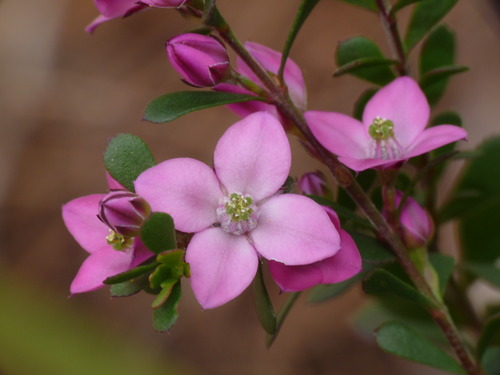
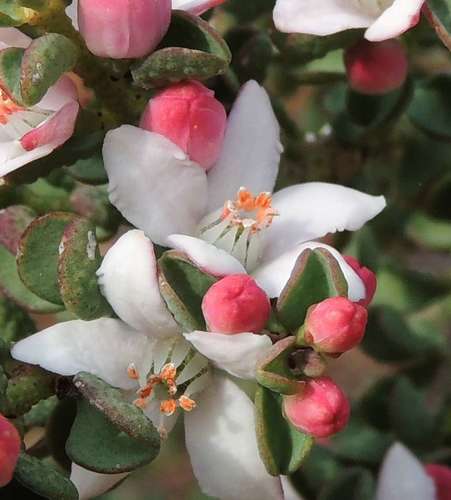
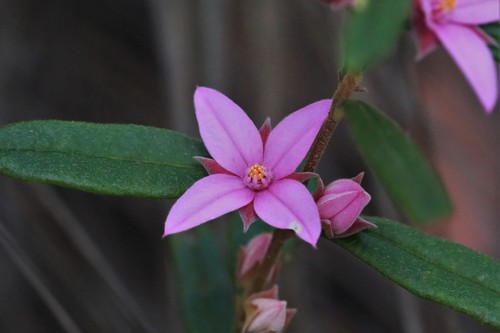
Boronia hapalophylla is an erect or straggling shrub that reaches around 3 metres (10 feet) in height. Its branches are covered in tiny, star-shaped hairs. The leaves of this species are simple, ranging in shape from narrow elliptic to lance-shaped. Most leaves are 18 to 50 millimetres (0.7 to 2 inches) long and 3.5 to 12 millimetres (0.1 to 0.5 inches) wide, with a paler, hairy underside and downward-rolled edges. Leaves are either sessile, meaning they have no stalk, or occasionally have a petiole (leaf stalk) up to 1.5 millimetres (0.06 inches) long. Flowers are pink, or sometimes white, and are arranged either singly or in groups of up to seven in leaf axils. When grouped, flowers grow on a peduncle up to 5 millimetres (0.2 inches) long, and individual flowers sit on a pedicel 2 to 6.5 millimetres (0.08 to 0.3 inches) long. There are four sepals, which are broadly egg-shaped to triangular; most are 5 to 10 millimetres (0.2 to 0.4 inches) long, 3 to 4.5 millimetres (0.1 to 0.2 inches) wide, and hairy on their outer surface. The four petals are 6 to 15 millimetres (0.2 to 0.6 inches) long, and are densely hairy on the back. Flowering occurs mainly in August and September. This boronia most often grows in open forest, and sometimes grows in thick gully vegetation. It is only found in 8 locations in the Grafton-Glenreagh area, and is relatively common within the Sherwood Nature Reserve and Yuraygir State Conservation Area.