About Boronia fraseri Hook.
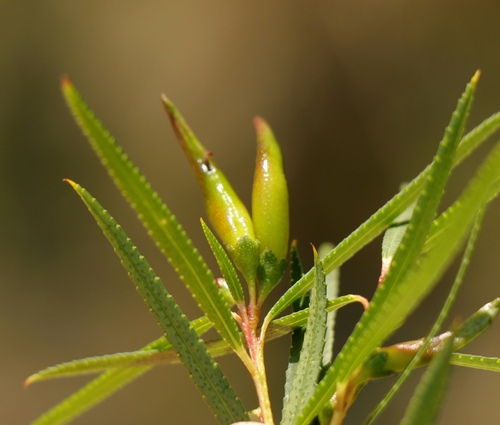
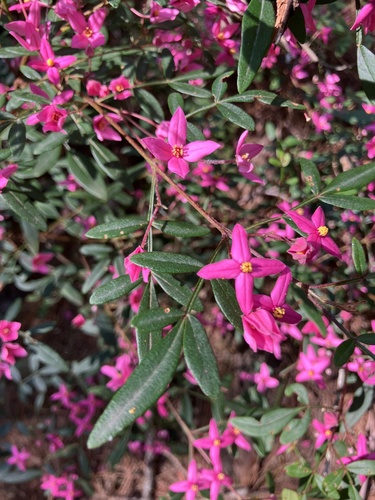
Boronia fraseri Hook. is an erect, many-branched shrub that reaches a height of around 2 meters (7 feet). Its branches are four-angled and mostly hairless. Its leaves are pinnate, with an overall outline 40 to 125 millimeters (2 to 5 inches) long and 35 to 70 millimeters (1 to 3 inches) wide, borne on a petiole 8 to 30 millimeters (0.3 to 1 inch) long. The leaves have between three and seven elliptic leaflets: the end leaflet measures 25 to 63 millimeters (1 to 2 inches) long and 8 to 16 millimeters (0.3 to 0.6 inches) wide, while side leaflets are 14 to 40 millimeters (0.6 to 2 inches) long and 3 to 13 millimeters (0.1 to 0.5 inches) wide. Between three and seven pink flowers grow on a stalk 3 to 15 millimeters (0.12 to 0.59 inches) long. The four sepals are egg-shaped to triangular, densely hairy on their back surface, 2.5 to 3 millimeters (0.098 to 0.12 inches) long and 1 to 2 millimeters (0.039 to 0.079 inches) wide. The four petals are 6 to 10 millimeters (0.24 to 0.39 inches) long and 4 to 5 millimeters (0.16 to 0.20 inches) wide, with hairs on the back. The eight stamens alternate in length: those opposite the petals are shorter than those located near the sepals. This species flowers from July to October, and its fruits are 4 to 5 millimeters (0.16 to 0.20 inches) long and 2.5 to 3 millimeters (0.098 to 0.12 inches) wide. Unlike many other Boronia plants, Fraser's boronia prefers moist gullies and rainforest areas, growing most often on soils derived from Narrabeen sandstone. It is mainly found in the Sydney region, and also occurs in the Blue Mountains. For cultivation, growing in well drained soils with part shade is recommended. Boronia 'Telopea Valley Star' is a hybrid of Boronia fraseri and Boronia mollis; this hybrid is hardier than its parents and has been grown in Australian gardens.