About Boronia alata Sm.
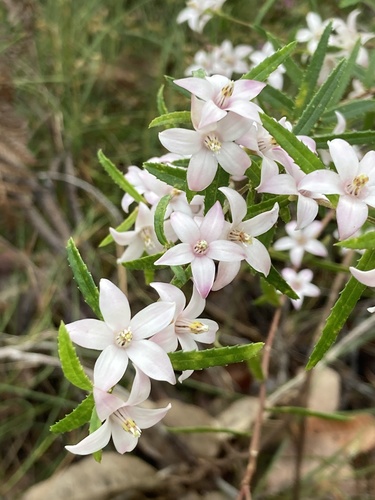
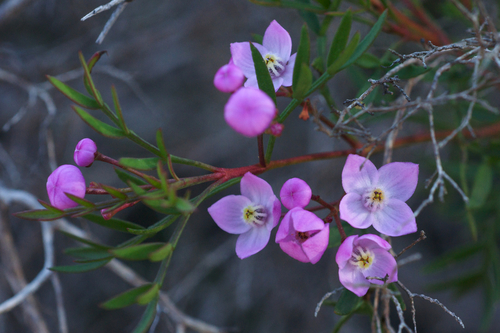
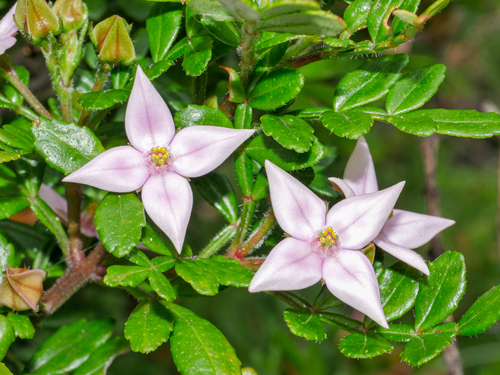
Boronia alata Sm. is generally an erect, multi-branched shrub that grows 2.5 metres (8 feet) tall and wide, but it sometimes grows as a prostrate shrub only 0.3 metres (1 foot) high in exposed locations. Its leaves are pinnate, typically bearing between seven and thirteen leaflets, and measure 15–65 mm (0.6–3 in) long and 10–40 mm (0.4–2 in) wide overall, with a 4–18 mm (0.2–0.7 in) long petiole. The leaflets are elliptic to lance-shaped, glossy dark green on the upper surface and paler on the lower surface. The end leaflet is 5–20 mm (0.2–0.8 in) long and 1–7 mm (0.04–0.3 in) wide, while side leaflets are 6–22 mm (0.2–0.9 in) long and 3–9 mm (0.1–0.4 in) wide. Flowers are pink or white, arranged in large panicle groups at the ends of branches, and sometimes also grow in upper leaf axils, on a 2–24 mm (0.08–0.9 in) long peduncle. This species has four narrow triangular sepals that are 2.5–3.5 mm (0.098–0.14 in) long and 0.5–1 mm (0.02–0.04 in) wide, and four petals 7–12 mm (0.3–0.5 in) long and 4–6 mm (0.16–0.24 in) wide. The eight stamens alternate in length, with those near the sepals longer than those near the petals. Flowering occurs from July to December, and the fruit are hairy capsules 4–5 mm (0.16–0.20 in) long and 2–3 mm (0.079–0.12 in) wide. This shrub is native to Southwest Australia, with most records coming from coastal areas, and disjunct records in the Esperance Plains, Jarrah Forest, Swan Coastal Plain, and Warren biogeographic regions. It grows in dense vegetation on sand at dunes and limestone cliffs. Boronia alata is cultivated as an ornamental plant, and can be propagated from cuttings. Like most boronias, this species prefers a heavily shaded growing position. Its persistent flowers open in Australian spring, and are more open and star-shaped than the concave or cupped flowers common to other boronias. Flowers are usually pink, and only rarely white. To replicate the species’ native growing conditions, growers can plant it in well-drained sand with deep mulch or sandstone sheets, which maintain available moisture and protect roots from high temperatures. This species was introduced to English gardens in 1824 as a small evergreen greenhouse specimen that flowers from May to July. Its flowers have a slight fragrance. For English garden enthusiasts, the vigorous rootstock of Boronia alata has been recommended for grafting with Boronia pinnata.