About Boreogadus saida (Lepechin, 1774)
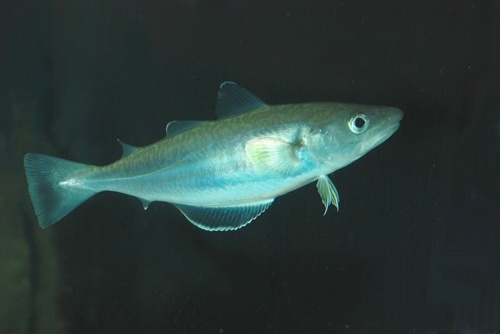
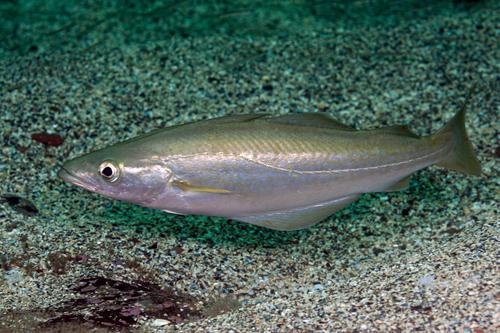
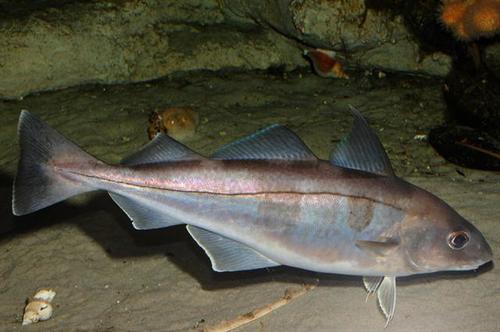
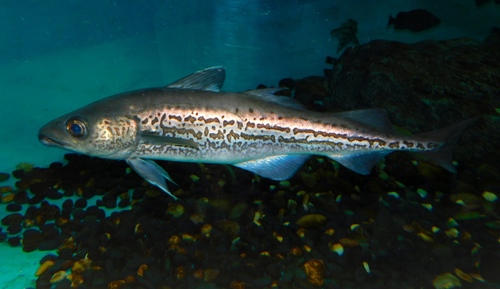
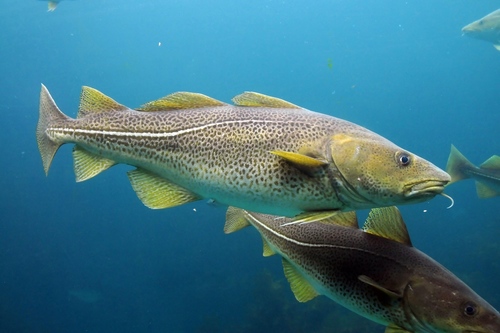
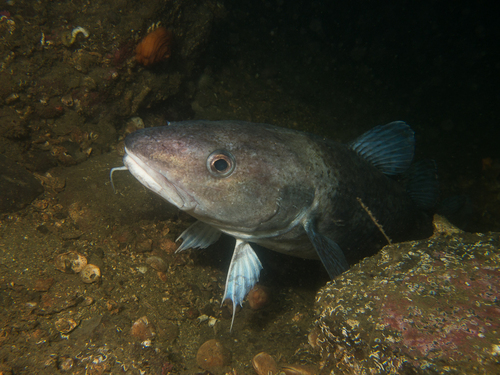
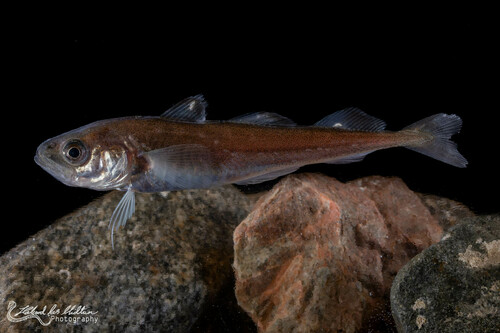
Arctic cod (Boreogadus saida (Lepechin, 1774)) have slender bodies, deeply forked concave tails, a projecting mouth, and a small chin barbel. They have three separate dorsal fins and two separate anal fins. Their pectoral fins extend beyond the end of the first dorsal fin, and their pelvic fins are made of elongated rays. The lateral line is interrupted along the full length of the body. Their coloration is plain, with a silvery body marked by brownish spots. Greenlandic Inuit fishers have recorded two morphotypes of this species: a lighter-colored variety and a darker-colored variety. Arctic cod are often misidentified as polar cod (Arctogadus glacialis) during their larval and early juvenile stages; the two species can only be distinguished by analyzing otoliths or using molecular data. Arctic cod reach an average total length of 25 cm (9.8 in), with a maximum recorded length of 40 cm (16 in).
This species has a circumpolar distribution in the North Polar Basin above Russia, Alaska, Canada, and Greenland, and ranges further north than any other fish, found beyond 84°N. Specifically, it occurs in the Arctic Ocean, Bering Sea, Chukchi Sea, Beaufort Sea, Hudson Bay, Baffin Bay, Greenland Sea, Barents Sea, Kara Sea, Laptev Sea, and Eastern Siberian Sea. Arctic cod inhabit nearly all Arctic and Subarctic marine habitats, including coastal waters, the mesopelagic zone, the deeper central Arctic Ocean, and areas under sea ice. They are the most abundant demersal Arctic species in the Beaufort Sea. The species exhibits diel vertical migration patterns during winter and spring, but no such migration is observed during summer.
Early life stages of Arctic cod are found near the surface in both ice-covered and open water, while adults occupy deeper areas of the water column. In the Canadian Arctic, Arctic cod separate vertically by size: younger fish live in the upper 100 meters (330 ft) of the water column, and juvenile and immature fish live below 200 meters (660 ft). Dense schools of Arctic cod can also be found near glacial fronts and polynyas. Subsurface plumes of freshwater discharged from glaciers form foraging hotspots, where zooplankton are stunned or killed by osmotic shock and become easy prey for Arctic cod. Greenlandic Inuit fishers have reported Arctic cod near the Sermilik and Sermeq Avannarleq glaciers off southwestern Greenland.
Arctic cod go through multiple reproductive cycles over their lifespan, and are an r-selected species: they reach sexual maturity early and produce large numbers of offspring. On average, a female lays between 9,000 and 21,000 eggs. Spawning takes place between September and April, and peaks between January and February. Exact spawning locations are not fully confirmed, but spawning is thought to occur in the Barents Sea southwest of the Svalbard Island chain, as well as the Kara and Pechora seas. In the Canadian Arctic, spawning is thought to occur near Franklin Bay and Darney Bay. In the Pacific Arctic, it is thought to occur in the northern Bering Sea, Chukchi Sea, and Kotzebue Sound. Greenlandic Inuit fishers have recorded a spawning area near Saattut Island.
The development and viability of Arctic cod eggs depend strongly on water temperature. Eggs develop normally between −1.5 and 3 °C (29 and 37 °F), but hatching success drops sharply above 2 °C (36 °F). Incubation time decreases as temperature increases: at 1.5 °C (35 °F), larvae hatch after 79 days, while at 3.8 °C (39 °F), incubation time drops to 29 days. In the Canadian Arctic, Arctic cod hatch under sea ice from January to July and remain under the ice until fall. Newly hatched larvae measure between 3.5 mm and 7 mm in length; in experimental settings, hatchling length decreases as water temperature increases. Larvae have a wider temperature tolerance range than eggs, and are euryhaline, meaning they can tolerate a range of salinity concentrations. This allows them to live in areas with glacial meltwater, at river mouths, and in ice-covered areas. Larger larvae have higher survival rates, particularly during the transition from yolk-based feeding to external feeding.
Juvenile Arctic cod have an even wider temperature tolerance range than larvae and eggs, tolerating temperatures from 0 to 12 °C (32 to 54 °F). The species shows isometric overall growth, but allometric fat storage. Juveniles live in the pelagic zone of the water column and move deeper after their first summer. Some juveniles are found within cavities in sea ice; it has been hypothesized that late-hatched juveniles remain associated with sea ice (sympagic) to avoid predation by adult Arctic cod and competition with other juvenile Arctic cod. Arctic cod reach sexual maturity at around 2 to 3 years of age. Adult Arctic cod can tolerate temperatures up to 13.5 °C (56.3 °F), and function best between 3 and 10 °C (37 and 50 °F). Adults are found deeper than 100 meters (330 ft) in the water column and are not associated with sea ice.