About Borago officinalis L.
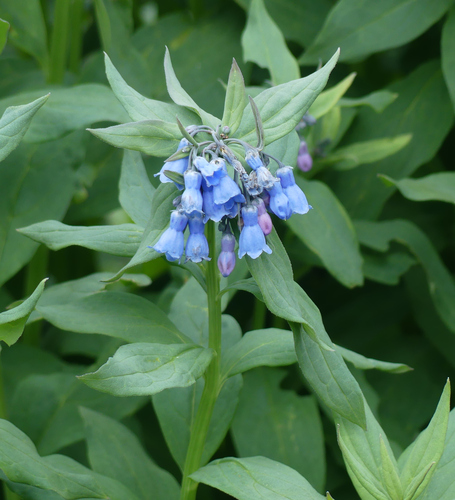
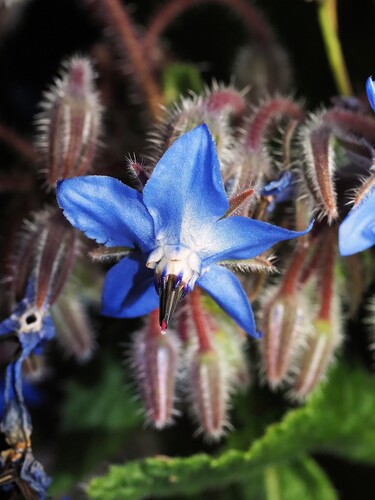
Borago officinalis L., commonly known as borage, reaches a height of 60 cm (2 feet). The entire plant is covered in bristly or hairy growth across its stems and leaves; its leaves are alternate, simple, and measure 5–15 cm (2–6 inches) in length. Borage flowers are complete and perfect, with five narrow, triangular-pointed petals. Most blooms are blue, though pink flowers occasionally appear, and white-flowered cultivars are also grown. Blue flower color is genetically dominant over white flower color. Flowers grow along scorpioid cymes, forming large floral displays with many simultaneous blooms, which indicates that borage has a high rate of geitonogamy, or intraplant pollination. Borage has an indeterminate growth habit. In temperate climates like that of the United Kingdom, its flowering season is relatively long, running from June to September. In milder climates, it blooms continuously for most of the year, and it can become invasive. Borage is native to the Mediterranean region, and has naturalized in many other areas. It grows well in gardens across most of Europe, including Ireland, Denmark, France, Germany, and the United Kingdom. It is not a perennial, but self-seeds readily to persist in gardens year after year. Leaves and seed oil of borage contain liver-toxic pyrrolizidine alkaloids (PAs). The German Federal Institute for Risk Assessment notes that borage honey can also contain these alkaloids, which are transferred to honey via pollen collected from borage plants. The institute advises that commercial honey producers can select raw honey with low PA content to prevent contamination. Historically, borage was cultivated for culinary and medicinal uses; today, most commercial cultivation focuses on growing it as an oilseed. Borage can be used as a fresh vegetable or a dried herb. As a fresh vegetable, it has a cucumber-like taste and is commonly added to salads or used as a garnish. Borage flowers have a sweet, honey-like taste and are often used to decorate desserts and cocktails, and are sometimes frozen in ice cubes for this purpose. Vegetable use of borage is common in Germany, the Spanish regions of Aragón and Navarre, the Greek island of Crete, and the northern Italian region of Liguria. While it is often added to soups, one of the most famous German borage dishes is Frankfurt’s specialty grüne Soße (green sauce). In Italy, borage is always eaten cooked, and is most often used as a filling for ravioli in the regions of Campania and Liguria. In Poland and Russia, it is used to flavor pickled gherkins. Borage flowers produce large amounts of nectar, which honeybees use to make a light, delicate honey. In traditional herbal medicine, Borago officinalis has been used to treat hyperactive disorders of the gastrointestinal, respiratory, and cardiovascular systems. This includes use for gastrointestinal issues such as colic, cramps, and diarrhea; airway conditions such as asthma and bronchitis; cardiovascular concerns, acting as a cardiotonic, antihypertensive, and blood purifier; and urinary disorders, acting as a diuretic for kidney and bladder issues. One case of status epilepticus has been reported in association with borage oil ingestion. A methanol extract of borage has shown strong amoebicidal activity in vitro; the 50% inhibitory concentration (LD50) of this extract against Entamoeba histolytica is 33 μg/mL.