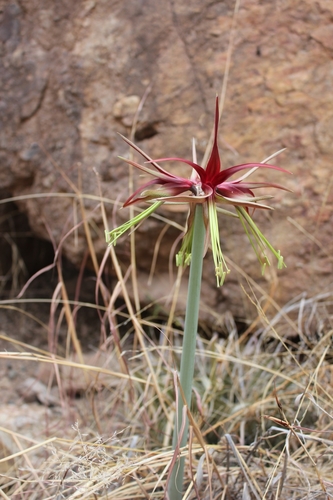
About Boophone disticha (L.f.) Herb.
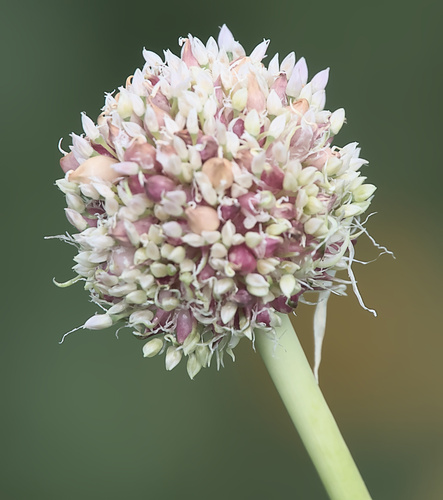
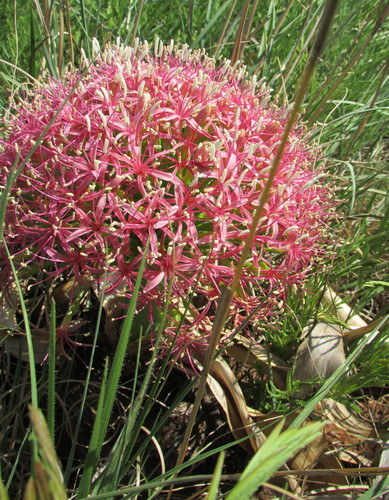
Boophone disticha is easily recognizable by its fan-shaped structure, which is formed by two tightly packed rows of around 15 leaves per row. It has a bulb that can reach up to 30 cm (12 inches) in diameter, with half of the bulb protruding above ground. Before the season’s new leaves emerge, it produces a single inflorescence: an umbel containing approximately 50 pink, six-petaled flowers. As the fruiting head matures, its pedicels stiffen and elongate significantly, growing to around 30 cm (12 inches) in length. When the fruiting head detaches from its stalk, it becomes a tumbleweed that can be moved easily by light winds, scattering its seeds as it rolls. Boophone disticha is native to the African region spanning from South Sudan to South Africa, and has been recorded growing in Angola, Botswana, Burundi, the Democratic Republic of the Congo, Eswatini, Kenya, Lesotho, Malawi, Mozambique, Namibia, Rwanda, South Africa (specifically in Eastern Cape, Free State, Gauteng, KwaZulu-Natal, Limpopo, Mpumalanga, and Western Cape provinces), Tanzania, Uganda, Zambia, and Zimbabwe. It grows wild in dry savannas, grasslands, and forest glades. The bulb of Boophone disticha has a broad range of applications in traditional African medicine. It contains multiple alkaloids including lycorine, undulatine, buphanisine, buphanamine, nerbowdine, crinine, crinamidine, distichamine, 3O-acetyl-nerbowdine, buphacetine, and buphanidrine, which have analgesic and hallucinogenic effects. Locally, it has been used to make arrow poison, and to treat equine piroplasmosis. The Khoi, Bushmen, and Bantu peoples knew that this plant is poisonous, and still used its parts for medicine and as arrow poison. Its key active compounds include eugenol, an aromatic volatile oil with a clove scent and analgesic properties, plus toxic alkaloids buphandrin, crinamidine, and buphanine. Buphanine has effects similar to scopolamine; if consumed in large amounts it can cause agitation, stupor, and strong hallucinations, and over-ingestion can lead to coma or death. Bulb material from this species was used in the preservation of the Khoi Kouga mummy discovered in the Langkloof.