About Bonasa umbellus (Linnaeus, 1766)
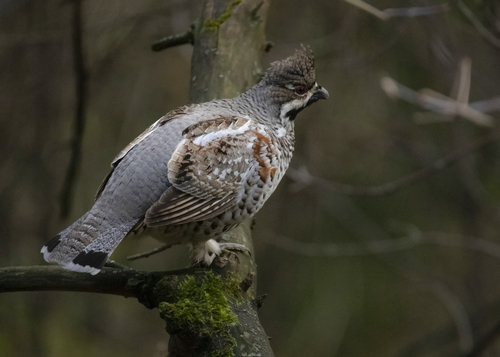
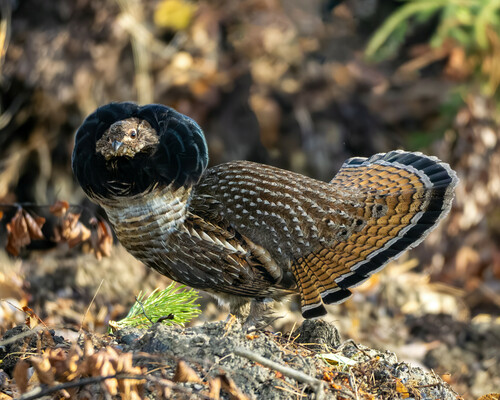
Bonasa umbellus, commonly called ruffed grouse, are chunky, medium-sized birds. They weigh 450–750 g (0.99–1.65 lb), measure 40 to 50 cm (16 to 20 in) in length, and have a wingspan of 50–64 cm (20–25 in) across their short, strong wings. This species has two distinct plumage morphs: grey and brown. For the grey morph, the head, neck, and back are grey-brown, the breast is light with barring, and there is a large amount of white on the underside and flanks. Overall, grey morph birds have a variegated appearance, and the throat is often distinctly lighter. The tail is primarily brownish grey with regular barring and a broad black subterminal band near the tip. Brown-morph birds have tails that match the color and pattern of grey morph tails, but the rest of their plumage is much browner. This gives brown-morph birds a more uniform appearance, with less light plumage on the underside and a noticeably grey-toned tail compared to the rest of their body. All types of intergrades occur between the two most typical morphs, and warmer, more humid conditions generally favor browner individuals. Both sexes have ruffs on the sides of the neck, and a crest on the top of the head that sometimes lies flat. The two sexes are similar in size and markings, making them difficult to distinguish even when handled. Females often have a broken subterminal tail band, while males usually have an unbroken subterminal tail band, though exceptions to this pattern are possible. Females may also perform a display similar to that of males. A fairly reliable identification marker is the markings on rump feathers: rump feathers with a single white dot indicate a female, while rump feathers with more than one white dot indicate a male. The average lifespan of a ruffed grouse is one year, though some individuals are thought to live as long as 11 years. Ruffed grouse are polygynous, and males may mate with multiple females during the breeding season. Like most grouse, ruffed grouse spend most of their time on the ground, and they particularly prefer mixed woodland with abundant aspen. They forage for food both on the ground and in trees, and are omnivorous, eating buds, leaves, berries, seeds, and insects. As nature writer Don L. Johnson noted: More than any other characteristic, it is the ruffed grouse's ability to thrive on a wide range of foods that has allowed it to adapt to such a wide and varied range of habitat on this continent. A complete menu of grouse fare might itself fill a book. One grouse crop yielded a live salamander in a salad of watercress. Another contained a small snake.