About Bombylius major Linnaeus, 1758
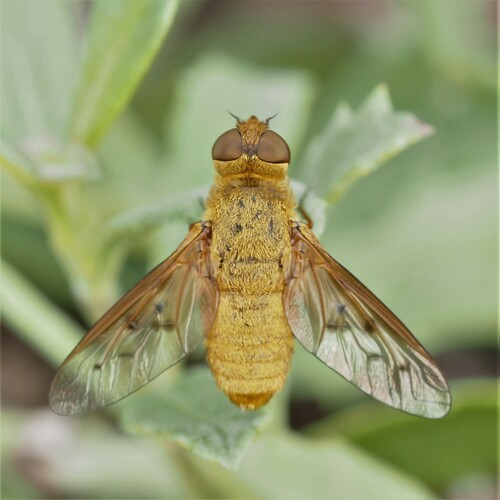
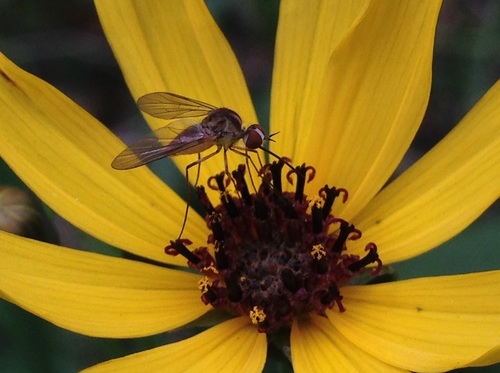
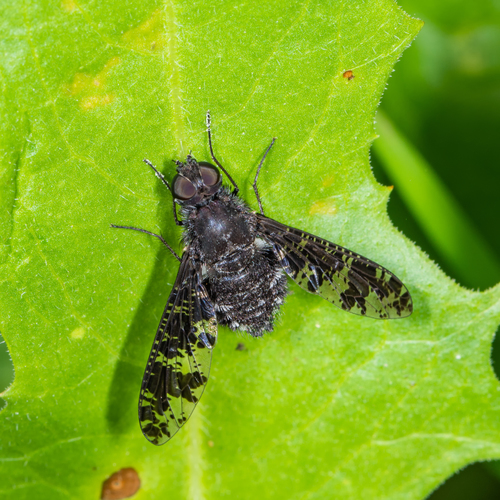
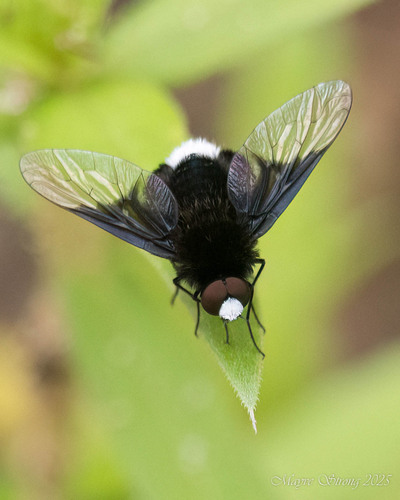
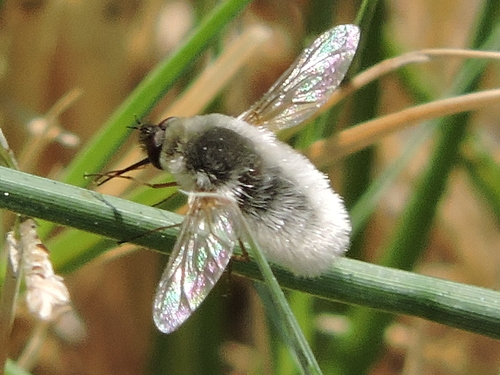
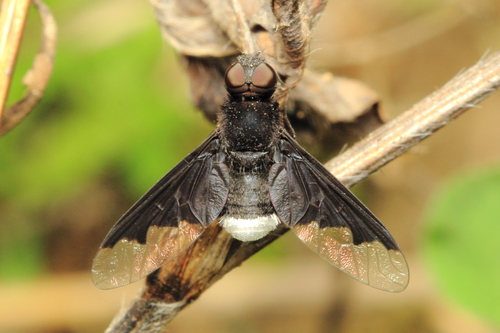
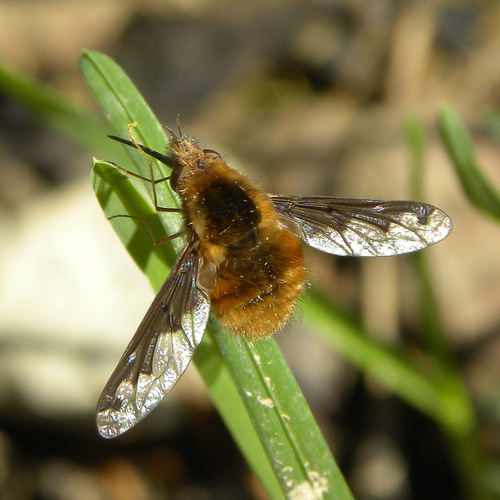
Bombylius major Linnaeus, 1758 is a member of the bee fly family Bombyliidae, a group that has around 6000 reported species worldwide. The subfamily it belongs to, Bombyliinae, contains approximately 1100 identified species, and the genus Bombylius currently includes around 450 described species. B. major is active from April to June, and can be found throughout temperate Europe, North America, and parts of Asia, with its distribution concentrated in the northern hemisphere. It occupies a wide variety of environments, ranging from arid to moist conditions. Adult B. major are medium-sized flies, with body lengths between 6.3 and 12 mm. Their base body color is dark, but their bodies are densely covered in a thick coat of lighter-colored hairs. The head is covered in mostly brown and black hairs, while the lower portion of the head is covered mainly in white hairs. The anterior half of the wings has dark patches, and the species has long, hairy legs that hang down when it is in flight. Its wingspan ranges from 8.4 to 14 mm, the wings are dark with a dark brown edge, and their bold pattern has a clear horizontal dividing border between the dark and clear portions of the wing. The antennae of B. major are typically very short and pointed. This species has long legs and a long, rigid proboscis that extends from the front of the head, which it uses to feed on flower nectar; the proboscis measures between 5.5 and 7.5 mm in length. When feeding, the fly beats its wings while its front legs grip the flower, and it inserts its long rigid proboscis to collect nectar. Despite its intimidating appearance, this proboscis is completely harmless. Males of the species are typically smaller than females. B. major moves by both hovering and darting between locations, and emits a high-pitched buzz during flight. B. major is most commonly observed in spring. Individuals begin to appear at the end of March, large numbers are seen through the end of May, and sightings continue into June. It is a holometabolous insect. B. major is a parasite that uses several host species, specifically the brood of solitary wasps and solitary bees, particularly digging bees of the genus Andrena. Females deposit eggs by hovering above the entrance to a host insect nest, most often a solitary bee nest, and flicking their eggs down into the entrance. The larvae are hypermetamorphic parasitoids, which feed on both the food stores stored in the nest and the young developing host bees or wasps. If a female cannot flick her eggs close enough to a host nest, she will lay her eggs on flowers that are visited by host insects. The developing larvae then either make their way to the host nest on their own, or attach to passing host bees or wasps to be carried back to the nest.