About Bombycilla japonica (Siebold, 1824)
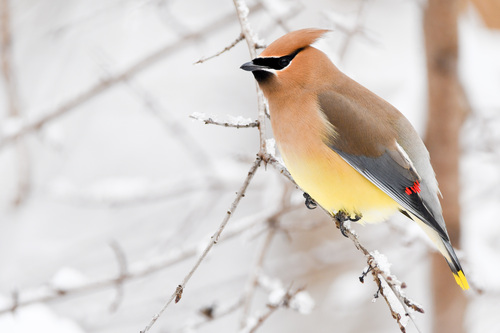
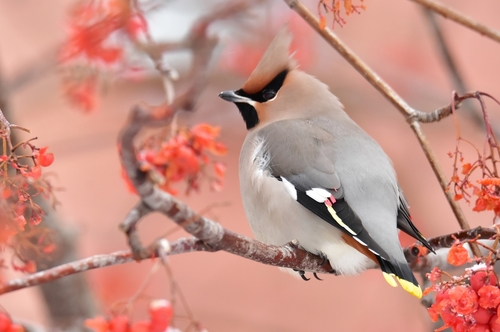
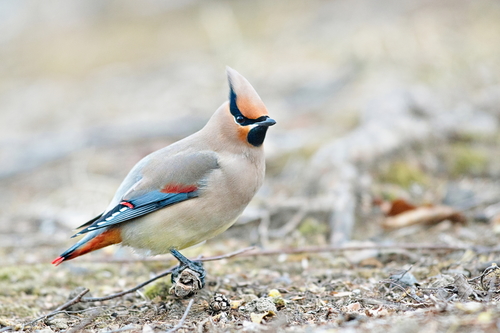
The Japanese waxwing, Bombycilla japonica, measures 15–18 cm long and weighs 54–64 g. Most of its plumage is pinkish-brown. It has a pointed crest, a black throat, a black stripe running through its eye, a pale yellow belly centre, a grey rump, rusty-red undertail coverts, and a dark grey tail with a red tip bordered by black. Its wings have a black, grey, and white patterned, with a diffuse reddish-brown bar across the greater covert feathers. This species produces a high-pitched trilling call, but it has no true song. Unlike the Bohemian waxwing, the row of red waxy secondary feather tips that gives the waxwing group its name only occurs in male Japanese waxwings, and these tips do not have the teardrop shape seen in Bohemian waxwings. Japanese waxwings frequently form mixed flocks with Bohemian waxwings. Bohemian waxwings usually have more prominent waxy tips, are slightly larger than Japanese waxwings, and have yellow tail tips, greyish belly centres, and no reddish-brown wing bar. Japanese waxwings breed in dense coniferous forests of the Russian Far East, including the Amur basin, northern Primorsky Krai, and Sakhalin, as well as the far northeast of China, covering Manchuria and Heilongjiang province. Outside the breeding season, they migrate south to winter in Japan, the Korean Peninsula, eastern China, and Taiwan. Their non-breeding distribution is irregular, as they move constantly to search for food, which mainly consists of seasonal berries. They may be abundant in one area one year, then leave the following year. In Japan, they are typically present from November to April. Few winter on Hokkaidō, but they outnumber Bohemian waxwings in southwestern Japan, including Kyūshū, Shikoku, and southern Honshu. In Taiwan, they are an irregular winter visitor, but large flocks may appear in some winters; hundreds were recorded in March 2020 during the 2019-2020 winter. Their winter habitat includes open woodland, low-lying farmland, and low mountains, and they often visit berry-filled trees in parks and private gardens. Vagrants have been recorded in Hong Kong and Central China. Records from locations further afield, such as Europe, South Asia, or the Middle East, are most likely escapes from captive aviculture rather than genuinely wild birds.