About Bombycilla garrulus (Linnaeus, 1758)
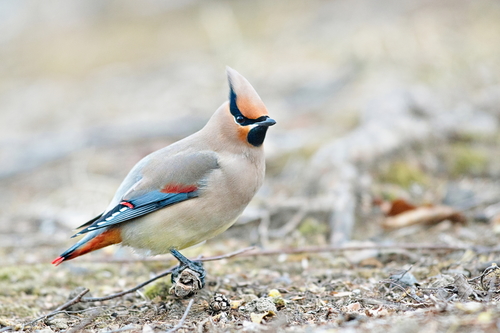
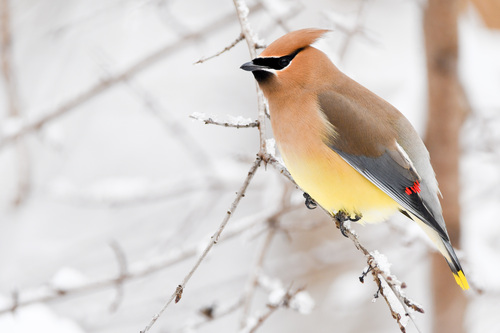
The Bohemian waxwing (Bombycilla garrulus) is a starling-sized bird, measuring 19–23 cm (7.5–9.1 in) in length, with a 32–35.5 cm (12.6–14.0 in) wingspan and an average weight of 55 g (1.9 oz). It has a short tail, mostly brownish-grey plumage, and a prominent crest on its head. Males of the nominate subspecies have a black mask running through the eye and a black throat, with a white streak behind the bill, a white curve below the eye, rich chestnut lower belly, cinnamon-colored areas around the mask, grey rump, and a tail that ends in a bright yellow band with a broad black border above it. The wings are very distinctive: flight feathers are black, and adult primaries have markings that create a yellow stripe and white "fishhooks" on the closed wing. Adult secondaries end in long red appendages that look like sealing wax, which gives the species its English common name. Eyes are dark brown, the bill is mostly black, and legs are dark grey or black. In flight, large flocks of Bohemian waxwings, with their long wings and short tail, look somewhat similar to common starlings, and their flight is equally fast and direct. They climb easily through bushes and trees, but only shuffle slowly across the ground. In adult birds, the primary feathers have a bright yellow leading edge near the tip, and a white "tick mark" on the tip of the trailing edge. For males, the yellow tail tip band is 6–11 mm broad, the black throat is sharply defined, and there are 6–8 red waxy tips on the secondaries. Females are very similar to males, but have a narrower yellow terminal tail band (4–8 mm), a less defined lower edge to the black throat, and slightly fewer red tips on the secondaries, 5–7. First-winter birds can be easily told apart from adults by the primary feather tips, which have a white or very pale yellow leading edge, and lack the white tick mark on the trailing edge. First-winter birds also have a slightly narrower yellow tail tip (5–10 mm in males, 2–6 mm in females), and fewer red wax tips on the secondaries: 4–6(–8) in males and (0–)1–5 in females. Juvenile plumage, only found on far northern breeding grounds, is noticeably duller than adult plumage, with streaky, whiter underparts, no black throat, and a smaller black face mask. Juveniles moult into first-winter plumage soon after fledging, before the end of summer. Compared to the nominate subspecies, the eastern subspecies B. g. centralasiae is paler, greyer, and has very little reddish-brown color behind the bill. The American subspecies B. g. pallidiceps has more color on the cheeks and forehead than the nominate form, and is otherwise generally duller in appearance. The species has soft, dense feathers that are maintained through preening. The red waxy tips are extended, flattened ends of feather shafts, pigmented with astaxanthin and covered by a transparent sheath. A study of the related cedar waxwing found that red tips are few or absent until the third year of life for that species. All adult Bohemian waxwings undergo a complete annual moult between August and January. Juveniles moult at the same time, but keep their flight feathers and some other wing feathers. The range of the Bohemian waxwing overlaps with the ranges of the other two living species in its genus. The cedar waxwing is smaller than the Bohemian waxwing; it has browner upperparts, a white undertail, a white line above the black eye patch, and lacks the white and yellow wing marks found on Bohemian waxwings. Adult cedar waxwings have a yellowish belly, and all ages have less strongly patterned wings than the Bohemian waxwing. The Japanese waxwing is easily distinguished from its relatives: it has a red terminal band on the tail, the black mask extends up the rear of the crest, and there is no yellow stripe and few or no red tips on the wings. The Bohemian waxwing's call is a high trill described as sirrrr. It is less wavering and lower-pitched than the cedar waxwing's call, and longer and lower-pitched than the Japanese waxwing's call. Other calls are just variants of this main vocalization: a quieter version is used by chicks to call their parents, and courtship calls (also given during nest construction) have an especially large frequency range. When a flock takes off or lands, the wings produce a distinctive rattling sound that can be heard up to 30 m (98 ft) away, though this is not classified as a call. The Bohemian waxwing has a circumpolar distribution, breeding in northern regions of Eurasia and North America. In Eurasia, its northern nesting limit lies just short of the treeline, roughly at the 10 °C July isotherm, and it breeds locally south to around 51°N. Most breeding individuals are found between 60–67°N, reaching as far north as 70°N in Scandinavia. The North American subspecies breeds in the northwestern and north central areas of the continent, with its range extending south beyond the US border into the Rocky Mountains. This waxwing is migratory, and most individuals abandon the full breeding range to move south for the winter. Migration begins in September in the northern part of the range, starting one month or more later further south. Eurasian birds normally winter from eastern Britain across northern parts of western and central Europe, Ukraine, Kazakhstan, and northern China, all the way to Japan. North American breeding birds follow a more southeasterly route, with many wintering in southeast Canada, and smaller numbers in the north central and northeastern US states. Birds do not usually return to the same wintering sites in consecutive years: one bird that wintered in Ukraine was found 6,000 km (3,700 mi) east in Siberia the following year. In some years, this waxwing irrupts far south of its normal wintering range, sometimes in huge numbers. The fruit that the birds depend on during winter varies in abundance from year to year; in poor fruit years, particularly those following a good crop the previous year, flocks move further south until they find enough food. They will stay in an area until the food is exhausted, then move on again. What may be the largest ever irruption in Europe occurred in the winter of 2004–2005, when more than half a million waxwings were recorded in Germany alone. This large invasion followed an unusually warm, dry breeding season. In 1908, an American flock 60–90 m (200–300 ft) wide was recorded taking two to three minutes to fly past a single point. The breeding habitat of the Bohemian waxwing is mature coniferous forest, often dominated by spruce, though other conifers and broadleaf trees may also be present. More open, wet areas such as lakes and peat swamps with dead and drowned trees are used for feeding on insects. In Eurasia, the species uses lowlands, valleys, and uplands, and generally avoids mountains. However, the North American subspecies nests in Canada at altitudes between 900–1,550 m (2,950–5,090 ft). Outside the breeding season, the waxwing uses a wide range of habitats as long as suitable fruit such as rowan is available. It may be found alongside roads, in parks and gardens, along hedges, or at woodland edges, and shows little fear of humans during this time. In winter, waxwings roost communally in dense trees or hedges, sometimes roosting alongside American robins, fieldfares, or other wintering bird species.