About Bombycilla cedrorum Vieillot, 1808
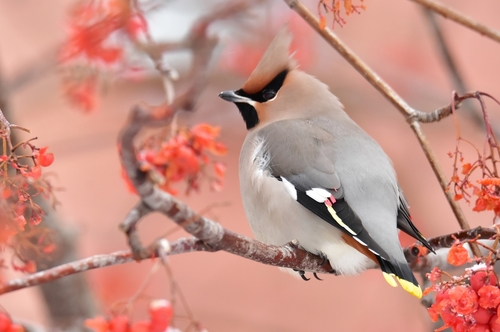
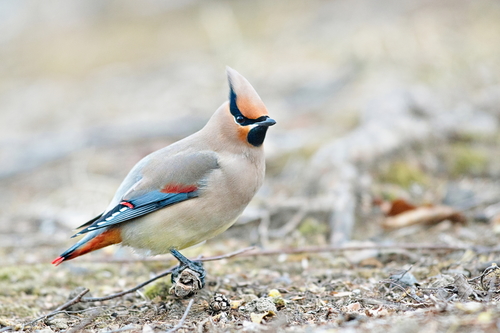
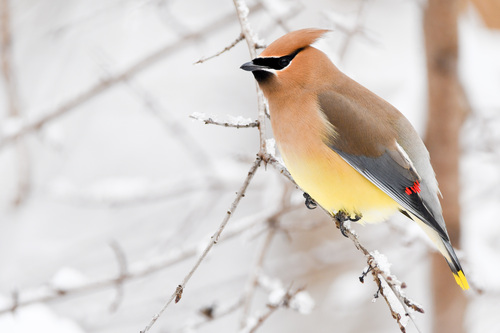
Cedar waxwings (Bombycilla cedrorum Vieillot, 1808) are medium-sized birds that measure approximately 6–7 inches (15–18 cm) long, weigh roughly 30 g (1 oz), and have a wingspan ranging from 8.7 to 11.8 inches (22 to 30 cm). Compared to their close relative the Bohemian waxwing, which breeds farther north and west, cedar waxwings are smaller and browner. Their overall plumage is described as a silky, shiny mix of brown, gray, and lemon-yellow, accented by a soft subdued crest, a distinct black mask, and brilliant red wax-like droplets on their wing feathers. These droplets may match the color of madrone berries, one of the foods cedar waxwings are known to eat. The most prominent feature of this species is the small cluster of these red wax-like droplets on the tips of the secondary flight feathers on the wings; this feature is shared with the Bohemian waxwing, but is not present in the Japanese waxwing. The wax-like droplets form when the pigmented and medullary layers of the secondary feather tip are surrounded by a transparent cuticle. Their wings are broad and pointed, similar to the wings of a starling. The tail is typically short and square-tipped, and its tip is yellow or orange depending on the bird's diet: individuals that feed on introduced Eurasian honeysuckle berries while growing their tail feathers develop darker orange-tipped tail feathers. Adult birds have a pale yellow belly. The cedar waxwing's crest often lies flat and droops over the back of the head. This species has a short, wide bill, and the black facial mask is outlined with a thin white border. Immature birds have streaked plumage on their throat and flanks, and often do not develop the black mask seen in adults. Male and female cedar waxwings look identical. Their flight is strong and direct, and flocks of flying cedar waxwings move in a pattern similar to flocks of small pale European starlings. Cedar waxwings fly at 40 km/h (25 mph), at an altitude of 610 m (2,000 ft). This species has several alternative common names: southern waxwing, Canada robin, cedar bird, cherry bird, and recellet. The oldest recorded cedar waxwing reached eight years and two months of age. Their preferred habitat is trees at the edges of wooded areas or forests, especially locations with access to both berry sources and water. They are frequently spotted in fruiting trees. Cedar waxwings are attracted to the sound of running water, and prefer to bathe in and drink from shallow creeks. In urban or suburban areas, they often favor parkland with well-spaced trees, golf courses, cemeteries, or other landscaped areas with well-spaced trees, berry-providing bushes, and a nearby water source such as a fountain or birdbath. They can also be found near farms, orchards, and gardens, particularly locations with fruiting trees or shrubs. Outside of the breeding season, cedar waxwings often feed in large flocks that can number hundreds of birds. This species is nomadic and irruptive, with erratic winter movements. Most of the population migrates farther south into the United States and beyond, sometimes reaching as far south as northern South America. They will travel in huge numbers when local berry supplies are low. Rare vagrants have reached western Europe, and there are two recorded sightings of cedar waxwings in Great Britain. Individual Bohemian waxwings will occasionally join large winter flocks of cedar waxwings. Cedar waxwings are sociable birds, and are found in flocks year-round. They are non-territorial, and will often groom each other. They move between locations to follow available berry food sources.