About Bombus ruderarius (Müller, 1776)
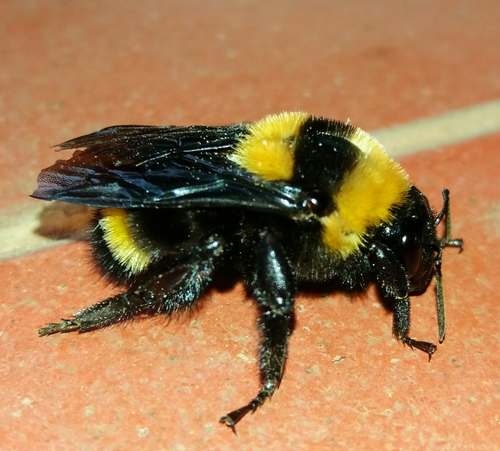
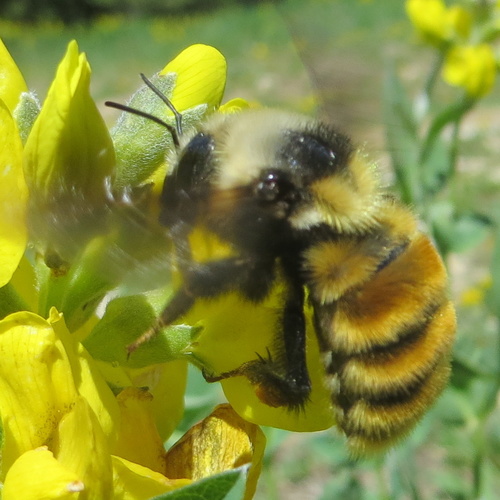
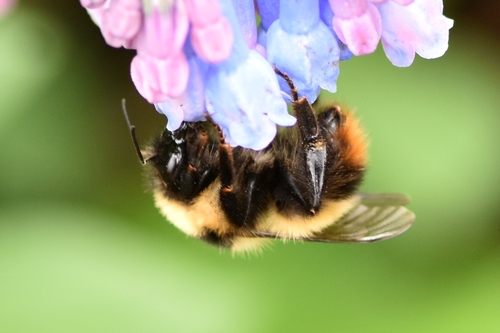
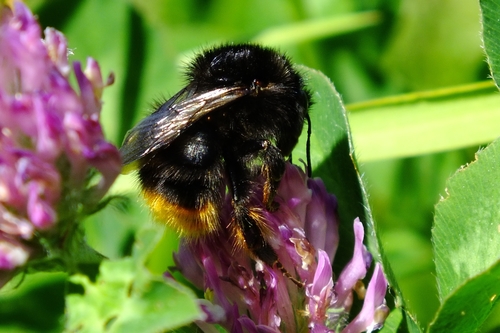
Bombus ruderarius is a bumblebee species that is sometimes confused with Bombus lapidarius, but differs slightly in appearance from B. lapidarius in multiple features. It is a relatively small bumblebee with a wide abdomen, an oblong face, and a fairly long tongue. Queens have an average length of 17 mm (0.67 in) and an average wingspan of 32 mm (1.3 in), and the other castes are smaller: workers average 15 mm (0.59 in) in length, while males average 13 mm (0.51 in). Most individuals have a prominent black body colour with a red tail. Males have a lighter colour variant that has yellow-green hairs on the thorax and the first two abdominal segments, called terga. The corbicula, or pollen basket, on the hind legs of females (both queens and workers) is covered in yellow-red hair.
This species ranges across Europe and northwest Asia. Its distribution extends from Ireland and Great Britain in the west to Siberia and northwest China in the east, north to the Gulf of Botnia and the Arctic Circle in Scandinavia, and south to North Africa, southern Italy, Greece, and the Balkans. Its populations are unevenly distributed across this range. It is considered very rare in North Africa, while it is very common in areas like the east Pyrenees, where it makes up more than half of all bumblebees recorded in the area. In Britain, Bombus ruderarius is declining due to habitat loss, and is currently restricted to southern England and western Scotland. It is classified as an endangered species in Ireland.
Nests of this species are built from grass or moss, located on or just below the ground, and usually hold between 50 and 100 workers. They most often repurpose old mouse nests found in open grassland and scrub. This species can also be found in sparsely developed urban areas including gardens and wasteland. Its recorded food sources are deadnettles, clover, vetch, and legumes such as bird's-foot trefoil.