About Bombus occidentalis Greene, 1858
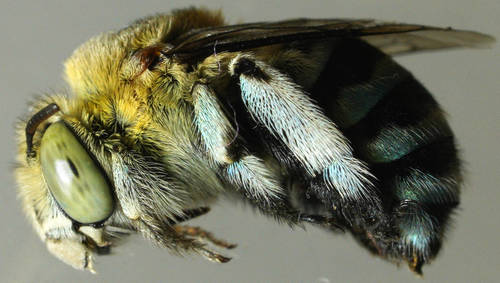
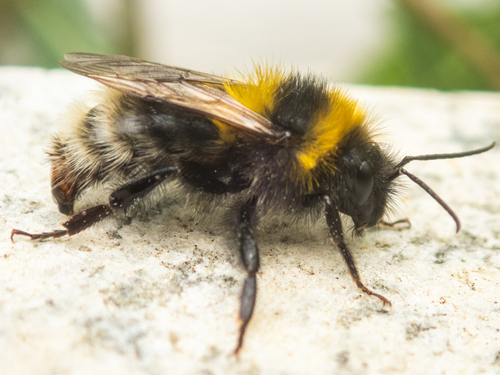
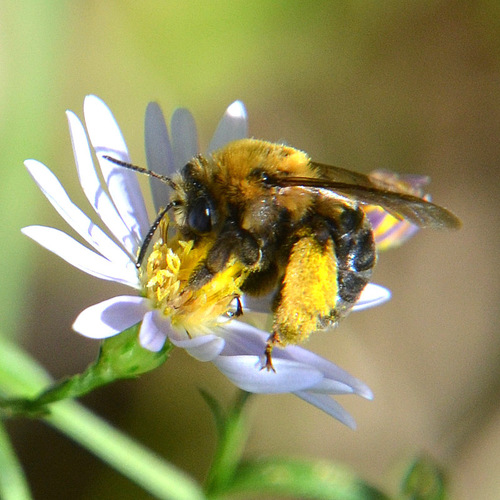
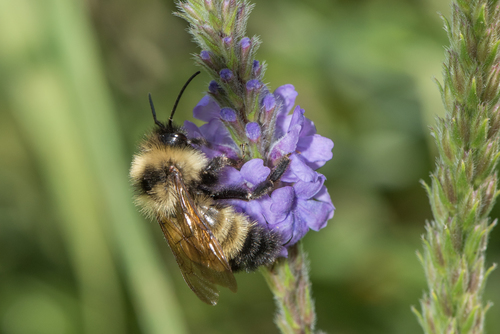
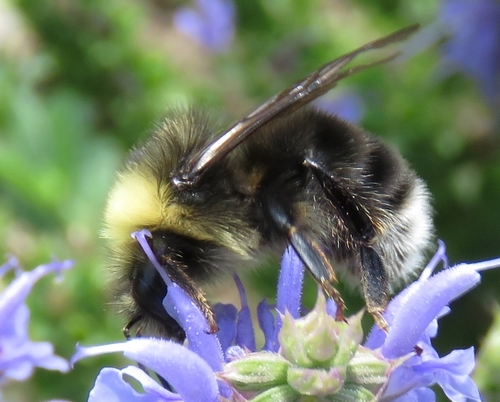
Western bumble bee (Bombus occidentalis) workers have three distinct main color variations, each linked to a specific geographic range. The first variation occurs from northern California north to British Columbia, and east to southwest Saskatchewan and Montana. Individuals in this region have yellow hair on the front part of the thorax, black hair on the basal section of the fourth abdominal segment, and whitish lower edges on the fourth and fifth abdominal segments. They also have sparse whitish hairs on the sixth abdominal segment that may appear black, and an entirely black head. The second color variation is found along California’s central coast. It has yellow hair on the sides of the second abdominal segment and across the entire third abdominal segment, with reddish-brown hair on the fifth abdominal segment. The third color variation occurs in the area from the Rocky Mountains to Alaska. It has yellow hair on the thorax behind the wings, on the rear of the second abdominal segment, and across the entire third abdominal segment. For bumble bee identification: all insects have three main body sections: head, thorax, and abdomen. Bumble bee species identification typically relies on the color patterns of abdominal segments. Abdominal segments are numbered from T1 to T6 (T7 for males), starting with the segment closest to the thorax and moving toward the abdomen’s tip. Bombus occidentalis was once one of the most common bee species in northwestern North America. It occurs from Mediterranean climate California all the way north to the tundra regions of Alaska, giving it one of the widest geographic ranges of any bee. However, the species has experienced a noticeable recent population decline. Over the past decade, the population of B. occidentalis has dropped by approximately 40.32%. The decline has been especially severe in California, western Oregon, and western Washington. The species’ overall range and population persistence have also decreased by around 20%. Some scientists attribute the population decline to the spread of Nosema, a parasite that infects bumble bees. Others suggest the decline may be caused by the invasion of European honey bees. A 2016 study indicates that the Western bumble bee population is currently rebounding, possibly due to evolutionary development of resistance to Nosema.