About Bombus muscorum (Linnaeus, 1758)
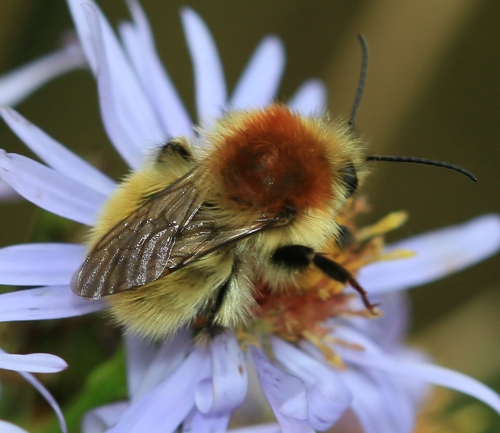
Bombus muscorum, the moss carder bee, can be identified by its oblong face and long tongue. Its body covering bristles are ginger in color, and cover its entire head, thorax, and abdomen; the abdomen may sometimes have a darker brownish color. In some subspecies, black bristles are mixed with the species’ characteristic ginger bristles, and some subspecies have an entirely black ventral side. This species looks very similar to the more common related species Bombus pascuorum. Queens of the species measure 17–19 mm in body length with a 32–35 mm wingspan. Workers measure 10–16 mm in body length with a 26–29 mm wingspan. Males measure 13–15 mm in body length with a 26–29 mm wingspan.
B. muscorum is widely distributed across Eurasia, ranging from Ireland in the west to Mongolia in the east. It can be found as far north as Scandinavia and Russia, and as far south as Crete. Despite this wide range, populations are fairly rare across the entire distribution. Populations in the United Kingdom have declined sharply since the 1970s. Once widespread across the British Isles, its current distribution is fragmented and concentrated mostly in coastal areas. In parts of Northern Britain, populations of other species such as Bombus pascuorum appear to be replacing B. muscorum, though the species remains relatively abundant in Northern Scotland. It is classified as Vulnerable in Europe by the IUCN.
This bumblebee lives in moors, grasslands, and salt marshes, and builds its nests above ground. In the British Isles, it nests in open lowland landscapes near coastal areas. In the northern part of the British Isles, its populations occur in moorland and machair; in the south, they are found in coastal marshes, shingle, and calcareous grasslands. Nests have also been recorded near open fallowed land and man-made ditches. Colonies of B. muscorum are small, containing between 20 and 100 workers.
Over recent decades, agricultural intensification in Europe has greatly reduced the natural habitat of B. muscorum. Most of the permanent flower-rich areas that the species commonly uses for foraging have been destroyed by expanded commercial farming. B. muscorum has poorer dispersal ability than other bumblebee species, which makes it more vulnerable to habitat loss. As a result, its populations have declined dramatically in recent decades.