About Bombus jonellus (Kirby, 1802)
Bombus jonellus is a fairly small bumblebee species. Queens reach a body length of around 16 mm (0.63 in), while workers and males measure around 12 mm (0.47 in). Queens have an average wingspan of 29 mm (1.1 in). This species has a short face and short proboscis.
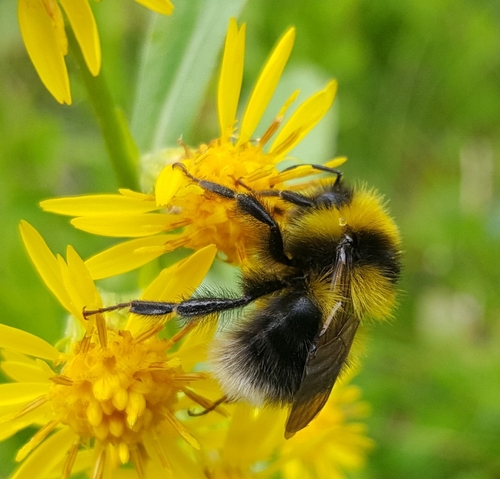
Female B. jonellus, which includes queens and workers, have a predominantly black abdomen, a yellow collar, yellow coloring on the first and sometimes second abdominal terga, and a white tail. Their face is black, occasionally with a patch of yellow fur on the upper portion. Males have a similar overall pattern but more yellow coloring overall: the yellow collar extends onto the ventral side, the first two terga are always yellow, and there is much more yellow fur on the face. Darker female forms exist, along with other forms (sometimes classified as subspecies) that vary in the amount of yellow fur and may have brownish hairs on the white tail. These described subspecies include B. j. hebridensis, which is endemic to Scotland’s Hebridean islands, B. j. monapiae, and B. j. vogtii. A form found on Orkney and the Hebrides has red tails rather than white tails in males.
Bombus jonellus occurs across most of Europe and a large portion of northern Asia. In western parts of its range, it is common from northern Iceland south to the Cantabrian Mountains in northern Spain. It is found beyond the Arctic Circle in Scandinavia and Russia, where its distribution is continuous north of 55°N and more uneven south of this line. In southern Europe, its distribution is also patchy, and it is restricted to mountain habitats. In Asia, its range extends east to the Gulf of Anadyr on the Pacific coast. In the United Kingdom, it is common in the southeast, East Anglia, and northern Scotland including the Hebrides, Orkney, and Shetland. It is also found in Alaska and Canada, east as far as Hudson Bay.
This species, commonly called the heath humble-bee, inhabits gardens, meadows, heath, and moorland. It visits a range of food plant sources including clover, bird's-foot trefoil, cowberry, thistles, and many others. Nests can be built either above or below ground, and hold a maximum of 50 to 120 workers. In regions with suitable climates such as southern England, this species can produce two broods per season. A study conducted in northern Sweden found that males patrol for young queens at tree-top height, marking twigs and leaves with pheromones to attract queens.