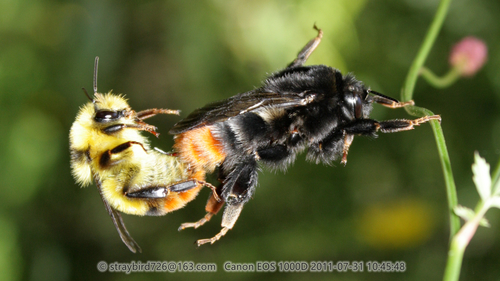
About Bombus ignitus Smith, 1869
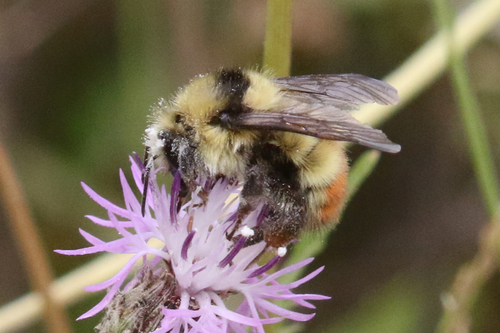
Bombus ignitus Smith, 1869 is a large bumblebee with a medium-length tongue. Females have black bristles covering the back of the thorax and mid-legs. The female abdomen is divided into five terga, where the first three terga (counted starting from the thorax) are black, and the fourth and fifth are orange-red. Males have golden yellow bristles that form two bands on the anterior and posterior thorax. Like females, the male abdomen is also divided into five terga. Counting from the thorax, the first two male terga are golden yellow, which distinguishes males from females; the third tergum is black, and the fourth and fifth are orange-red, matching the coloration of female terga. Compared to females, males have smaller compound eyes and shorter antennae that only reach the base of the wings. Among bumblebee species, male B. ignitus have uniquely greatly broadened penis valves that flare outward to form a funnel shape. Queens have a body length of 19 mm (0.75 in), workers measure 15–17 mm (0.59–0.67 in), and males have a body length of 17 mm (0.67 in).
This species occurs in the Palearctic realm, primarily in humid temperate regions of East Asia, including China, Japan, and Korea. Populations have been recorded at a mean altitude of 1425 m on the western, southern, and eastern foothills of the Sichuan Basin, and while uncommon, populations also occur at lower altitudes.
For medical research, a protein called BiVSPI found in the venom of B. ignitus has been identified as a serine protease inhibitor. BiVSPI has antimicrobial activity, and is known to inhibit the growth of Gram-positive bacteria and fungi. The cDNA of four antibacterial peptide genes—apidaecin, hymenoptaecin, abaecin, and defensin—has been isolated and cloned from B. ignitus. Synthesized abaecin from this species inhibits the growth of Gram-negative bacteria, but has very little inhibitory effect on the growth of Gram-positive bacteria.