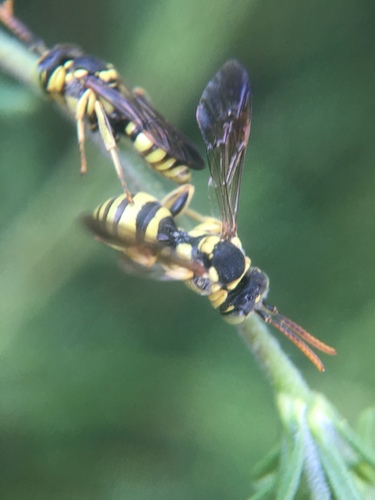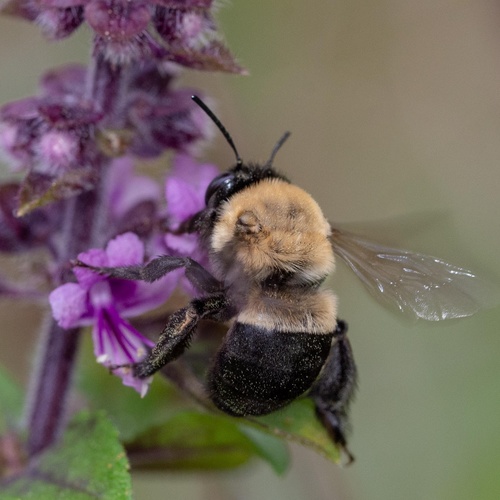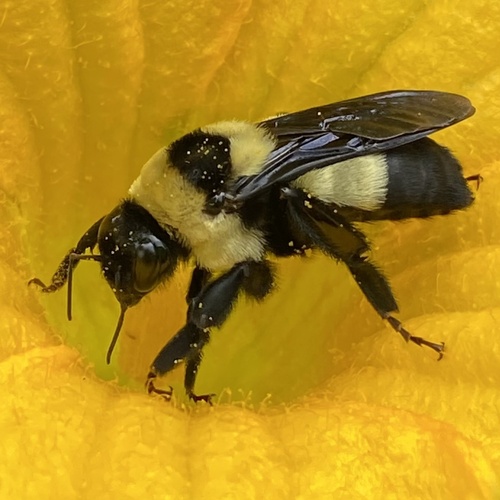
About Bombus fraternus (Smith, 1854)
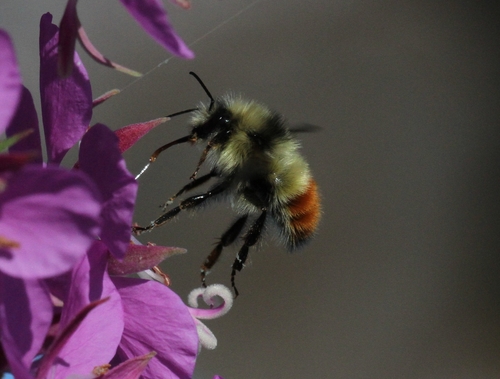
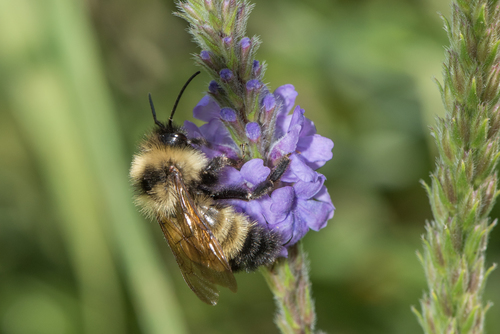
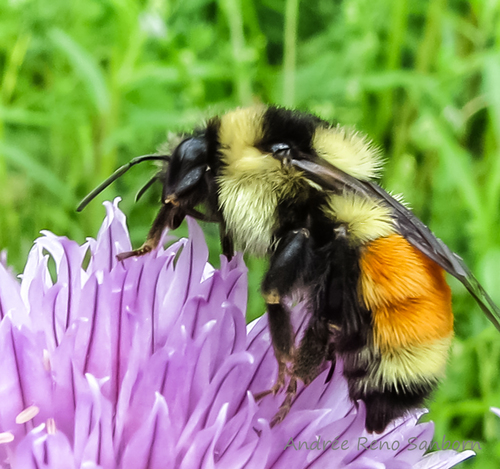
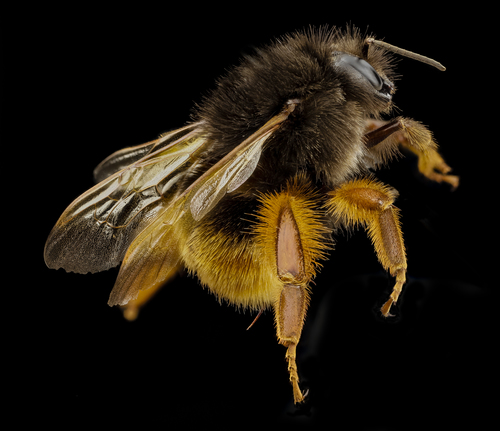
Bombus fraternus, commonly called the southern plains bumblebee, is primarily black with yellow bands across the thorax and abdomen that distinguish it from other bumblebee species. It is larger than most other bumblebees, and unusual among bumblebees for having flattened abdominal hairs rather than the fluffy hairs seen on most other species. Queens range in size from 0.97 to 1.07 inches (25-27 mm), while workers measure 0.56 to 0.75 inches (15-19 mm); queens and workers share very similar coloration. A female’s body is covered in short yellow and black hairs, with distinctive flattened black hairs on the third abdominal tergal segment. Hairs on the face and sides of the thorax are usually black. The metasoma (the upper side of the abdomen) is nearly rectangular and slightly flattened, with yellow hairs on the first and second tergal segments, while the third tergal segment is entirely black. Males are also large, ranging from 0.85 to 1.00 inches (22-25 mm), and have much larger eyes and longer antennae than females. Their antenna segments are nearly three times the length of the antenna base, called the scape. Males have the same core coloration pattern as females, but the area between their wings is sometimes extensively yellow. The southern plains bumblebee inhabits open prairies, meadows, and grasslands of the southeastern coastal plain and the entire Great Plains from Texas to North Dakota. It is a generalist forager, with documented floral associations with flowering plants from at least 20 plant families. Confirmed food plants for this species include Asclepias, Bidens, blanket flower, bush clover, Cassia, Eryngium, Hypericum, Liatris, Melilotus, Monarda, Padus, Ratibida, Solidago, and Vaccinium. This species adapts to both open natural and human-modified habitats, and can be found in intact prairie, agricultural land, and urbanized areas that have suitable floral and nesting resources. It has recently been observed near St. Louis, at both an urban farm and a restored prairie. The southern plains bumblebee nests underground. Like most bumblebees, it is an opportunistic nester that does not dig its own underground nests; it instead uses pre-existing underground holes and depressions created by rodents or other animals, or above-ground cavities formed by old logs, stumps, abandoned ground-nesting bird nests, or clumps of grass. After mating, mated females require sites to hibernate through the winter. The specific requirements of this species’ overwintering sites are not yet known; overwintering sites are distinct from colony nesting sites, and may or may not be located near foraging areas. In general, bumblebees hibernate close to the ground surface or one to two inches deep in loose soil, or under leaf litter or other debris, in undisturbed sites with adequate organic material for shelter. Historically, the southern plains bumblebee ranged across the southern and central Great Plains and along the southeastern coastal plain. It has been observed in 27 U.S. states. It was rarely recorded in the northernmost part of its range, in North Dakota and Michigan. This species was never confirmed to be present in Wisconsin. There are a small number of records from the Mexican state of Chihuahua, but none of these records date to the past decade. There are no known records of this species from Canada.