About Bombus dahlbomii Guérin-Méneville, 1835
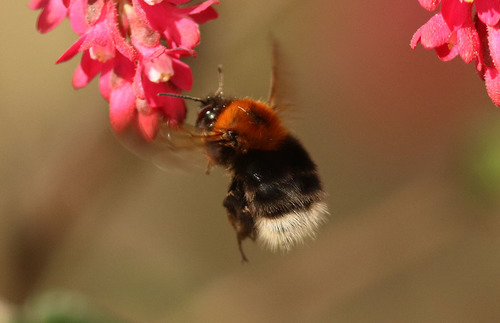
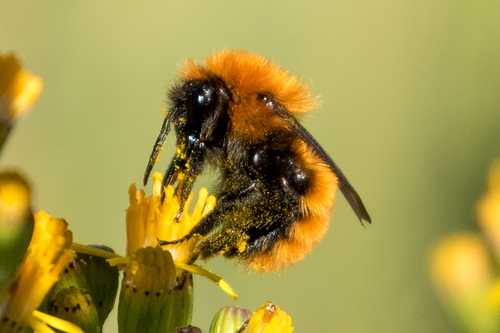
Bombus dahlbomii Guérin-Méneville, 1835 is predominantly red-orange in color. Its entire thorax is red-orange, while its abdomen is generally a lighter shade of orange that becomes even lighter or discolored near the tip. Like most bumblebees, it has a rounded abdominal tip. Its head, wings, and legs are distinctly black. It has relatively short antennae, with a distinct larger forewing and smaller hindwing that are usually tucked above the thorax, lying almost flat against the body. Relatively long bristles cover almost all of its thorax and abdomen, giving it an extremely furry appearance; the head and leg regions are covered in shorter bristles than the thorax and abdomen. Queens typically have body masses between 0.5 and 1.5 grams, and head-to-tail lengths reaching up to 4 cm. These measurements make Bombus dahlbomii one of the largest bumblebees in the world, earning it the nickname "flying mouse".
Bombus dahlbomii is the only native bumblebee species of southern South America. Its range extends from 30 degrees south to the southern tip of mainland South America. It is endemic to temperate forest regions of central and southern Patagonia, and is distributed across Patagonia, where it coexists with two non-native bumblebee species: Bombus terrestris and Bombus ruderatus. Across its range in Chile and Argentina, including Patagonia, it occupies forest environments with both continuous and scattered, fragmented distributions of plants, flowers, and other resources. Individuals living in these two types of environments have slightly different morphological and behavioral features. While there are unsubstantiated reports of Bombus dahlbomii occurring outside southern South America, its range is relatively confined compared to other South American bumblebees.
Bombus dahlbomii is an important pollinator for multiple plant species, including Lapageria rosea and Alstroemeria aurea, in Chile and Patagonia. It plays an especially critical role pollinating fragmented plant populations in the Maulino forest of Chile. Research shows that individuals in fragmented environments have longer wings relative to their body size than individuals in continuous forests, because they require longer-distance flights, which favors longer-winged individuals. Overall, Bombus dahlbomii is a much more efficient pollinator than species from other tribes such as Apis (Apini), other genera such as Chalepogenus (Anthoporidea), and other insect orders. While it is also a more efficient pollinator than the invasive Bombus ruderatus, Bombus dahlbomii visits plants less often than this invasive counterpart.