About Bombina variegata (Linnaeus, 1758)
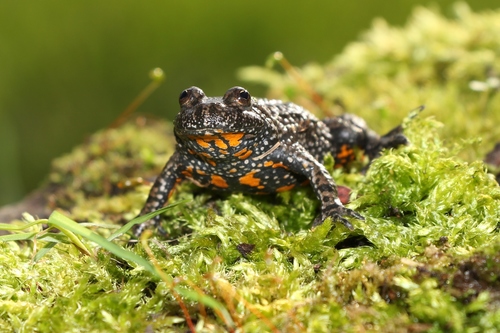
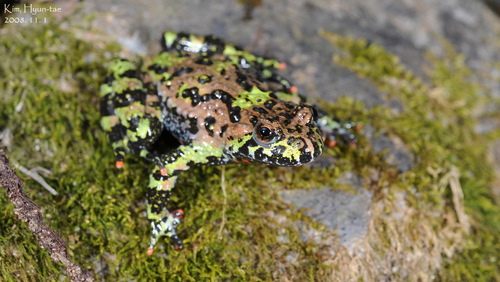
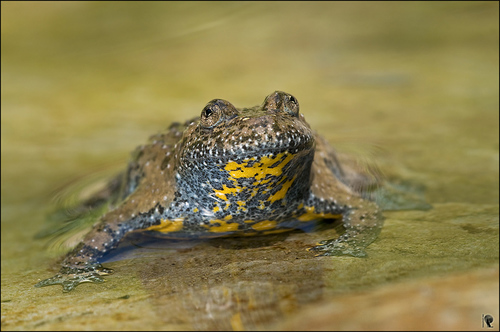
Adult specimens of Bombina variegata range from 28 to 56 mm in length, and typically weigh between 2.3 and 12 g. This makes the species one of the smaller members of the family Bombinatoridae, whose members can reach up to 7 cm in size. The dorsal (upper) side of the yellow-bellied toad is grey-brown, and often bears faded, bright spots. The ventral (under) side, including the inner surfaces of the limbs, fingers, and toes, is grey-blue to black-blue, with prominent bright yellow to orange spots or patches that usually cover more than half of the underside. Yellow-bellied toads have compact bodies – though not as flattened as their close relative the European fire-bellied toad – and a rounded snout. Their pupils are heart-shaped, and their eardrums are not visible. The dorsal side is covered in numerous warts with raised swirls. A study by researchers from Brill Academic Publishers found that this species has sexual dimorphism: males have a notably longer humerus, which results in longer forelimbs. This longer forelimb length is thought to give males an advantage during mating coupling and fights with other conspecific males. The yellow-bellied toad inhabits mountainous regions, primarily in Western Europe. Two Bombina species occur in Europe: Bombina variegata and Bombina bombina. Following postglacial range expansion of Bombina bombina, Bombina variegata populations have become less abundant. Yellow-bellied toad populations are also restricted to much smaller, more isolated geographic areas. The most common regions where the toad is found include France, Germany, Belgium, and the Netherlands. Habitat disturbances have caused a significant decrease in the species' area of occupancy. Female yellow-bellied toads are physiologically capable of producing offspring multiple times per mating season, and the species can produce long-lived individuals. However, it is rare to find females that actually produce multiple clutches of offspring per year. Female reproductive output is also very low: while females are capable of laying over 200 eggs in a single clutch, they typically only lay around 40 eggs. This lower output is explained by the lack of evolutionary incentive for larger clutches when adult survival rates are high, while offspring survival rates are more variable. Yellow-bellied toad tadpoles develop rapidly, and can reach 55 mm in length. They have a blunt tail and are typically grayish-brown, or transparent in rare cases. Both tadpoles and eggs are vulnerable to predation from various small pond-dwelling organisms, including leeches, fish, and some aquatic beetles. A 2016 study published in the Canadian Journal of Zoology found that tadpoles developing in warmer water develop faster than tadpoles in cooler water. These temperature conditions mimic the differing environments found in forested areas and sunny quarries, respectively.