About Bombina orientalis (Boulenger, 1890)
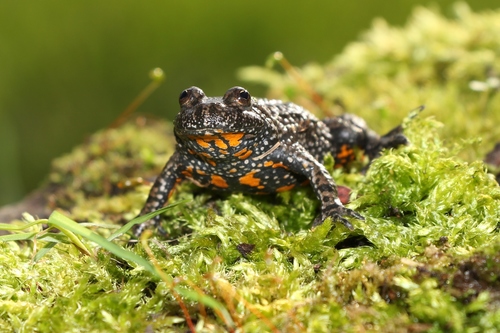
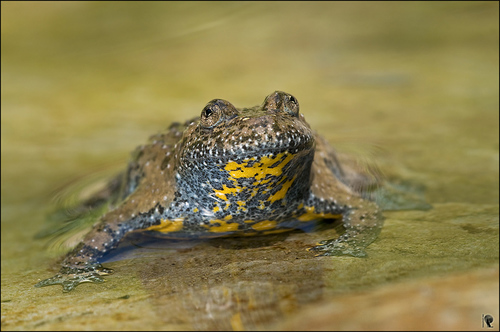
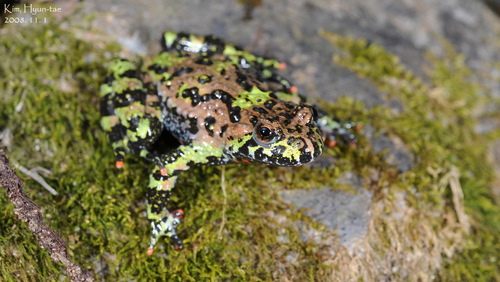
Oriental fire-bellied toads, scientifically named Bombina orientalis (Boulenger, 1890), can be bright green, grayish green, or brownish green, with black mottling on their dorsal surfaces. Like other species in the genus Bombina, B. orientalis has a brightly colored ventral region, which may be yellow, red, or orange-red, mottled with dark spots. Its finger and toe tips are usually red. The skin on its upper side is covered in small tubercles, which are the most pronounced among all species in the genus Bombina. Even though this species is commonly called a toad, it is not a true toad. Adult Oriental fire-bellied toads reach a length of about 3.8–5.1 centimetres (1.5–2.0 in) and weigh about 28–57 grams (0.99–2.01 oz). Males can be distinguished from females by the presence of nuptial pads on the males’ first and second fingers. In addition to having more prominent skin tubercles, B. orientalis can be told apart from other Bombina species by its lack of gular sacs (this trait is shared with B. pachypus and differs from B. bombina). It was originally thought to also lack nuptial pads, a trait shared with B. bombina and differing from B. pachypus, but later research confirmed that males do have a small number of nuptial pads as noted above. Subtler distinguishing features include belly coloration that is typically more red than yellow, which differs from B. pachypus, and bright colored finger tips, which differs from B. bombina. This species is distributed across Korea, northeastern Russia (where populations have become quite rare), and northeastern China. Its reported presence in southern Japan, specifically the Tsushima Strait area, is very likely incorrect, as a team of Japanese researchers was unable to locate any specimens there in the latter half of the 20th century. A genetically distinct introduced population exists in Beijing; this population was brought from Yantai, Shandong, and released by Mr. Liu Cheng-chao in 1927, when approximately 200 individuals were released into local wetland habitats, where the population later successfully established through breeding. Multiple reports have documented escaped specimens in Broward County, Florida, United States, mostly found near the facility of an animal importer. No other escaped populations have been reported in the United States, and no well-established feral populations are known from the country. Oriental fire-bellied toads are semiaquatic, and generally live in slow-moving streams or ponds. When on land, they are most often found in coniferous and broadleaved forests. They occur at elevations up to 1,100 metres (3,600 ft). They are very resilient to environmental disturbance, especially when compared to other amphibians, so they can survive and even breed in heavily polluted water. Within its native range, Bombina orientalis is one of the most abundant amphibian species, particularly in the central portion of its range. The species is diurnal, meaning it is active during the day. Studies have found that while Oriental fire-bellied toads get some vitamin D3 from their diet, they also rely partially on sunlight to get adequate levels of vitamin D3.