About Bombina bombina (Linnaeus, 1761)
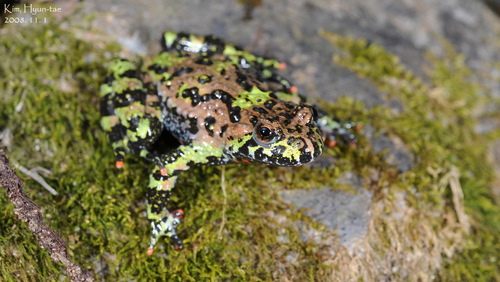
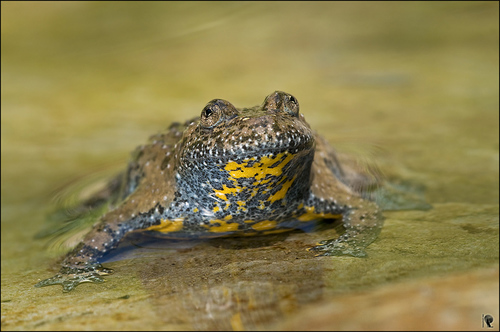
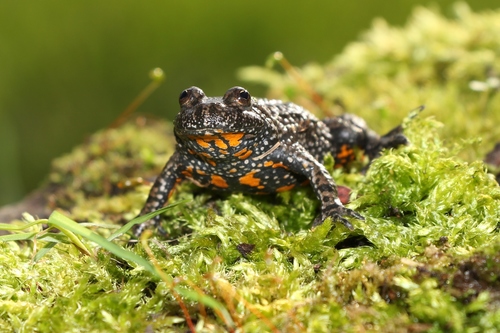
The European fire-bellied toad, with the scientific name Bombina bombina (Linnaeus, 1761), is a medium-sized frog that grows to approximately 5.6 centimetres (2+3⁄16 inches). Its dorsal coloration can range from gray to brown to green, while its stomach is red with thick black mottling. The backs of these frogs are covered in warts. When threatened by a predator, the fire-bellied toad lifts its arms, sometimes flipping over, to expose its red coloration and advertise its toxicity to the potential predator. This behavior is called Unkenreflex, and is an example of aposematism.
The European fire-bellied toad is found across Central and Eastern Europe. More specifically, its natural range starts in eastern Germany, and includes eastern Denmark and parts of southern Sweden, extending east to the Volga District of Russia, where the Ural Mountains form its eastern boundary. Its southernmost range reaches Bulgaria and the Marmara region of Turkey. There is an introduced population of European fire-bellied toads in Lorraine, France, over 500 kilometres (310 miles) away from their natural range in eastern Germany. This population was first discovered in 2009 in Moselle, and has since been found in several other nearby locations up to 30 kilometres (19 miles) away, which indicates intentional human translocation. This introduced population can potentially impact local yellow-bellied toads via hybridization.
While the IUCN lists this species as "Least Concern", it has experienced population declines across much of its range. For example, 15 known breeding populations of these frogs were recorded in Denmark in 1974, but by 1988 only 8 of these populations remained. In Puszcza Romincka Landscape Park in Poland, the fire-bellied toad is described as uncommon; it is rare in Coastal Landscape Park, and in an amphibian survey conducted in Warsaw, fire-bellied toads made up only 9% of observed species. However, in some areas the species is recovering through human conservation intervention. One example is Funen County, Denmark, where dozens of ponds were dug for the frogs to live and breed in, leading to an approximately five-fold population increase over a decade.
In terms of ecology, the European fire-bellied toad generally prefers lowland habitats such as ponds and marshes with low levels of woody vegetation. In larger lakes, these frogs stay along the edges, at depths of 50 to 70 centimetres (20 to 28 inches), in reed beds and floodplains. They feed on a wide variety of small invertebrates, particularly springtails, beetles, flies, and ants. In turn, adult frogs are preyed on by many other animals including snakes and birds, while tadpoles are eaten by leeches and fish. They typically enter hibernation when temperatures drop to 4 °C (39 °F), burrowing into soil or rotting logs and remaining in torpor until spring. Breeding begins once temperatures reach 16 °C (61 °F), and usually takes place at night or early morning. Females deposit between 15 and 40 eggs, with clutch size depending on the female’s body size. Tadpoles hatch after about one week, and develop for approximately one month before undergoing metamorphosis at a size of around 3.8 centimetres (1+1⁄2 inches).