About Bolinopsis infundibulum (O.F.Müller, 1776)
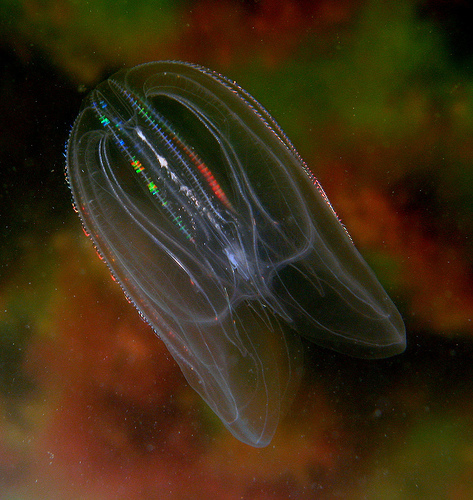
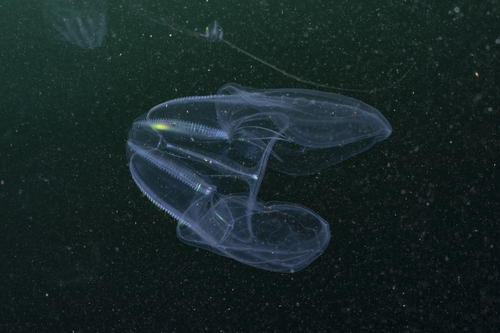
Bolinopsis infundibulum is an oblong comb jelly that reaches a maximum length of about 15 cm (6 in). It has a thin, gelatinous, transparent body wall that is occasionally milky white. It has two short tentacles with fringed edges. The mouth is located at one end of the body, with two large lobes beside it that funnel food toward the mouth. Between the lobes are four auricles, which are gelatinous projections fringed with cilia. These auricles create feeding currents that help draw in microscopic prey. A ring of small tentacles called tentilla surrounds the mouth. The opposite end of the body is bluntly pointed. Locomotion is powered by four long longitudinal rows and four short rows of cilia. These cilia are arranged on transverse plates and beat in synchrony, giving the comb jelly an iridescent appearance. The cilia's attached plates are bioluminescent. Ctenophores (comb jellies) differ from cnidarians because they do not have stinging cells; instead, they use colloblasts to capture prey. Bolinopsis infundibulum is found in the northern Atlantic Ocean, where its range extends from the Arctic south to the Mediterranean Sea in the east, and to the Gulf of Maine in the west. It is also present in the Pacific Northwest, ranging from the Bering Sea south to California. It occurs at depths down to about 1,000 m (3,281 ft), with the largest individuals found at greater depths. Bolinopsis infundibulum is a predatory comb jelly that sometimes forms swarms. Feeding currents created by ciliary movement draw food toward its mouth. Weakly swimming prey including fish eggs and fry, copepod larvae, gastropod veligers, rotifers, and other tiny zooplankton are trapped by the tentilla and ingested. This species is an important part of the marine food chain. It occurs in large numbers off the coast of Norway from April to August, and off Scotland from April to June. Populations have been recorded as dense as 250 individuals per square metre in mid-May, followed by a rapid population decline. This sudden collapse is thought to be caused by predation from another comb jelly, Beroe cucumis. Larger individuals of B. infundibulum, found in deeper waters, have been reported preying on copepods later in the year.