About Boletus subluridellus A.H.Sm. & Thiers
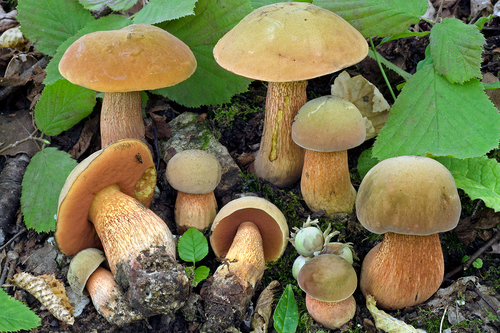
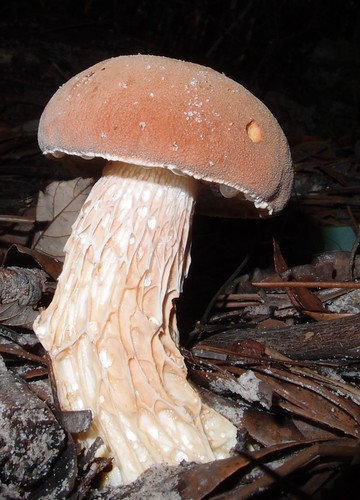
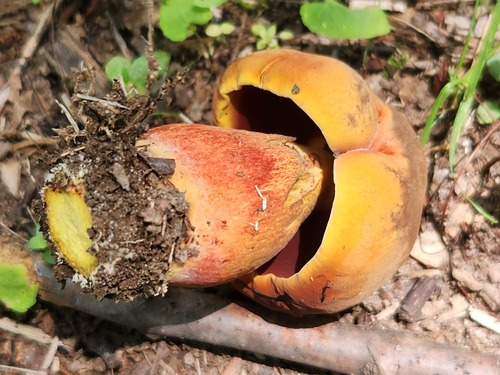
The fruit bodies of Boletus subluridellus have convex caps 5–10 cm (2–4 in) in diameter. The cap surface is dry, slightly sticky, and has a somewhat velvety texture, with a color ranging from reddish to reddish-brown to orange-red. The flesh is bright yellow, and turns blue when cut. It has no noticeable odor and a slightly metallic taste.
On the underside of the cap, the tubes that make up the pore surface are 6–9 mm (0.24–0.35 in) long. Close to where the cap connects to the stipe, these tubes are either unattached to the stipe or slightly depressed. The small, round dark reddish pores measure about 2–3 pores per mm.
The stipe is 4–9 cm (1.6–3.5 in) long and 1.5–2.3 cm (0.6–0.9 in) thick. It is solid, meaning not hollow or filled with pith, and is roughly the same width along its entire length. The stipe is pale yellow, fading to reddish at the base, which has flattened, pressed-down yellow hairs. All parts of the fruit body: cap surface, flesh, pores, and stipe, stain blue quickly when injured or touched.
The spore print of Boletus subluridellus is olive-brown. Spores are somewhat fuse-shaped when viewed from the face, and inequilateral in profile. They have a smooth surface, a tiny apical pore, dimensions of 11–15 by 4–5.5 μm, and cell walls around 0.2 μm thick. The spore-bearing basidia are club-shaped, four-spored, and 8–12 μm thick. Pleurocystidia, which grow on the tube walls, measure 28–42 by 6–11 μm with a 3-μm neck, while cheilocystidia on the pore edges are narrowly club-shaped and slightly smaller, measuring 26–38 by 4–8 μm. Pleurocystidia usually do not protrude further than the sporulating basidia.
The cap cuticle is made of a 150 μm-thick layer of narrow hyphae 3–5 μm wide, arranged more or less as a trichodermium, where the outermost hyphae grow roughly parallel like hairs, perpendicular to the cap surface. These hyphae stain red when mounted in Melzer's reagent and yellow when mounted in potassium hydroxide. Clamp connections are not present in the hyphae.
Boletus subluridellus is a mycorrhizal fungus that grows in association with deciduous trees, particularly oak of the genus Quercus. Fruit bodies grow scattered or in groups on the ground in deciduous or mixed forests, and appear between July and October. It is an eastern North American species, found from New England west to the Great Lakes, and north to Quebec, Canada.