About Boletus rex-veris D.Arora & Simonini
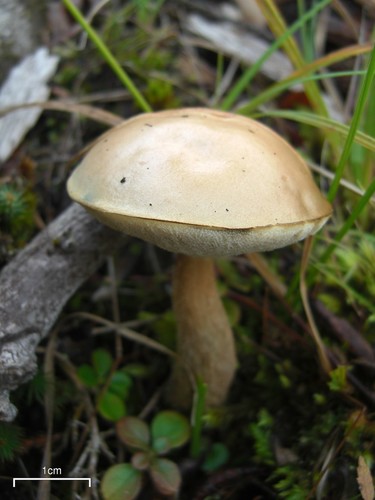
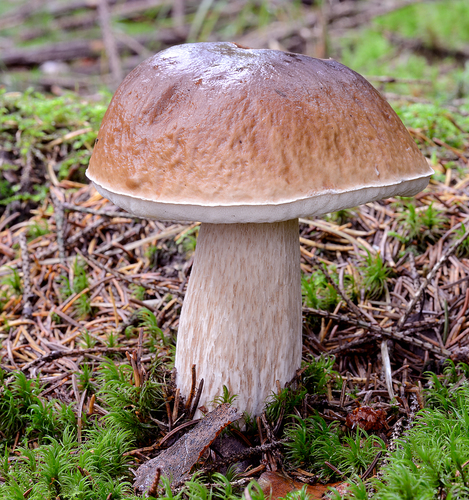
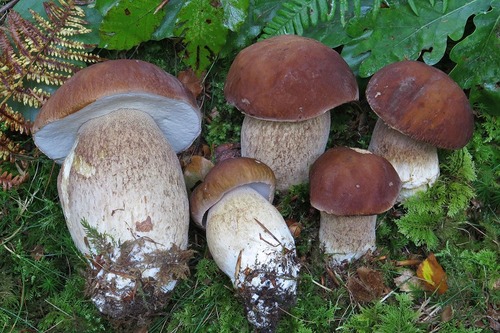
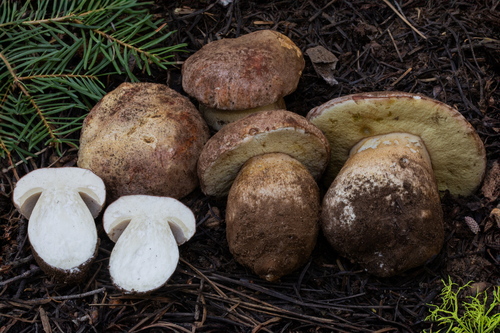
Boletus rex-veris D.Arora & Simonini, commonly known as the spring king bolete, is a basidiomycete fungus in the genus Boletus native to western North America. Its large edible fruiting bodies (mushrooms) grow under pine trees, typically appearing between May and June. The species has a pinkish to brownish cap, and an often large, swollen stem; the overall fungus may carry an orange-red tinge. Like other boletes, the size of its fruiting body is variable. Boletus rex-veris is edible, and can be preserved and cooked. For many years, Boletus rex-veris was classified as a subspecies or form of the porcini mushroom Boletus edulis. In 2008, a taxonomic revision of western North American populations of this group was published, formally establishing Boletus rex-veris as a distinct species. Phylogenetic analysis shows that B. rex-veris belongs to a closely related clade with B. fibrillosus, B. pinophilus, B. subcaerulescens, B. subalpinus, and B. regineus. In terms of distribution and habitat, Boletus rex-veris grows under pines (Pinus ponderosa, P. contorta subsp. murrayana) and firs (Abies concolor and other Abies species) at elevations between 3,000 and 7,000 feet, or 910 to 2,130 meters. The fungi are often buried under needle duff, and fruit from May to June in California. In Oregon, they fruit at lower elevations, and the species' range extends north into Washington, east to Idaho, and north to British Columbia.