About Boletus pinophilus Pilát & Dermek
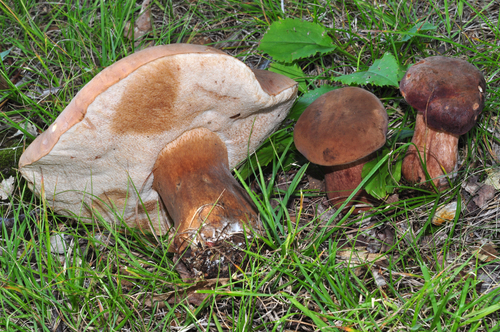
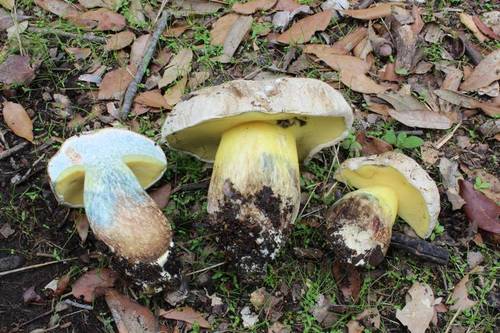
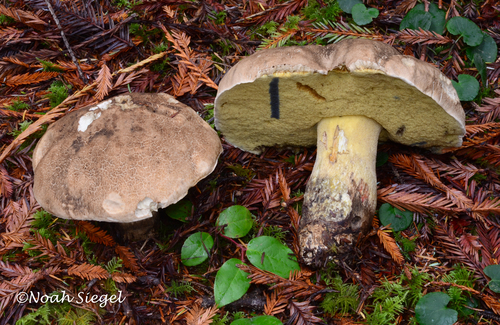
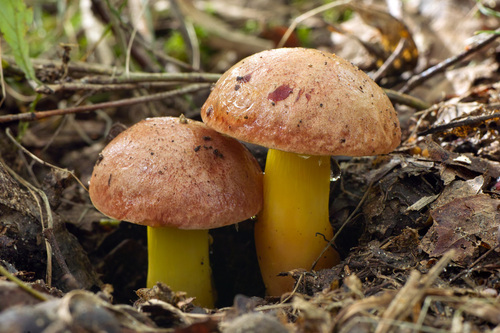
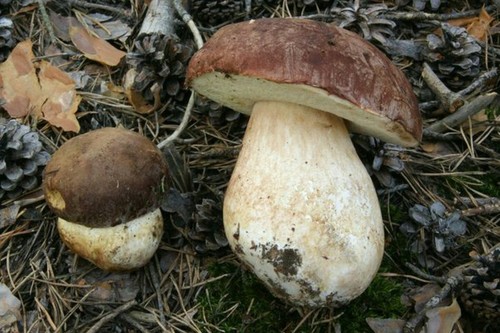
Boletus pinophilus Pilát & Dermek produces fruiting bodies with convex caps. When young, the cap is small relative to the stipe, and it expands in volume as the mushroom matures. The cap skin is dry, matte, and ranges in color from maroon to reddish-tinted chocolate brown. It is thicker and gelatinous compared to other porcini-like boletes, and these features visually distinguish it from close relatives such as Boletus edulis, B. reticulatus and B. aereus. Young, immature caps may be pale pink and covered in a white, powdery coating. Like all boletes, B. pinophilus fruiting bodies vary greatly in overall size: the cap can reach up to 40 centimeters (16 inches) in diameter, while the stipe can grow up to 25 cm (10 in) tall and 16 cm (6+1⁄4 in) across. The stipe is typically bulbous and swollen, and bears a coarser reticulated (network) pattern than that seen on other porcinis. The stipe’s overall color often has an orange-red tinge that is most visible on the lower sections, though this trait also occurs in other related species. Like other boletes, B. pinophilus has small pores rather than gills on the underside of its cap. The pores are white when young, turn yellow as they age, and become olive-brown when fully mature. The species produces cylindric-ellipsoid, smooth spores that contain oil drops, measuring 15.5–20 by 4.5–5.5 μm, and it leaves an olive-brown spore print.
B. pinophilus is the rarest of Europe’s porcini-like mushrooms, but it is found across temperate regions. It occurs in Britain, where it is more common in Scotland; in France, where it is more common in the south; and it is also present in Leningrad Oblast and Vologda Oblast in Russia, and in Ukraine. This bolete is classified as vulnerable in the Czech Republic. Its range extends into Asia Minor and southwestern Asia, and it reaches as far east as Perm Krai in central Russia and Irkutsk Oblast in Siberia. It has also been found growing in exotic pine plantations (such as those of Pinus sylvestris) in eastern North America, Mexico, Chile, South Africa and New Zealand. Most native populations previously identified as this species from China and North America have now been confirmed to be other distinct species.
B. pinophilus forms ectomycorrhizal symbiotic relationships with pine (Pinus) species, including stone pine (P. cembra), black pine (P. nigra), Corsican pine (P. nigra subsp. laricio), cluster pine (P. pinaster), Monterey pine (P. radiata), Scots pine (P. sylvestris) and P. uncinata. It also associates with European silver fir (Abies alba) and European spruce (Picea abies). It can be found wherever these host trees grow, particularly with Scots pine in Britain, and it prefers poor, acidic, sandy soils in coniferous forests. The species appears to favor pines, and the form that grows with fir and spruce has been named B. pinophilus var. fuscoruber. It is not restricted to conifers, however, and can also fruit in deciduous forests under chestnut (Castanea sativa), oak (Quercus spp.), and beech (Fagus sylvatica), and possibly under birch (Betula spp.) and hornbeam (Carpinus spp.). Fruiting bodies grow singly or in small groups from summer through autumn, though they have been recorded appearing as early as April in Italy. A 2007 field study of four bolete species found little correlation between the abundance of above-ground fruiting bodies and the presence of below-ground mycelia, even in soil samples collected directly under mushrooms. The study concluded that the triggers for mycorrhiza formation and fruiting body production are more complex than previously assumed.
Boletus pinophilus is edible, and can be used fresh, preserved, dried, and cooked the same way as other edible boletes. Its flesh is white, soft in mature specimens, and does not change color when bruised. It has a pleasant taste and smell; people native to La Malinche compare its flavor to pork and pork crackling. It is easily misidentified as the porcini B. edulis due to their similar habitats and appearances. It is a highly valued edible mushroom, especially in southern European regions including Portugal, the Basque Country and Navarre in Spain, France, Italy, Bulgaria and Serbia. In the area around Borgotaro, in Italy’s Province of Parma, four species including B. edulis, B. aereus, B. reticulatus, and B. pinophilus are recognized for their exceptional taste and officially called Fungo di Borgotaro. These mushrooms have been collected and exported commercially from this area for centuries. It is commonly eaten in Turkey, particularly in the Marmara and Western Black Sea regions, and is exported to Europe. It is also sold commercially in Finland, and can command high prices when sold dried in central Mexico. Fresh B. pinophilus is up to 90% water and rich in carbohydrates. Unsaturated alcohols are the main component of porcini mushroom aroma; the main volatile compounds in B. pinophilus are 1-Octen-3-ol, 2-octen-1-ol, 3-Octanone, (E)-2-octenal, oct-1-en-3-one, 1,7,7-trimethyl-heptan-2-one, 2-propenoic acid and 1,3-octadiene. B. pinophilus is known to bioaccumulate the heavy metals mercury, cadmium and selenium. To reduce exposure to these pollutants, authorities recommend avoiding collecting this mushroom from polluted areas such as sites near mines, smelters, roadways, incinerators and waste disposal sites. It is also recommended to remove the pores before consumption, as they hold the highest concentrations of these pollutants.