About Boletus barrowsii Thiers & A.H.Sm.
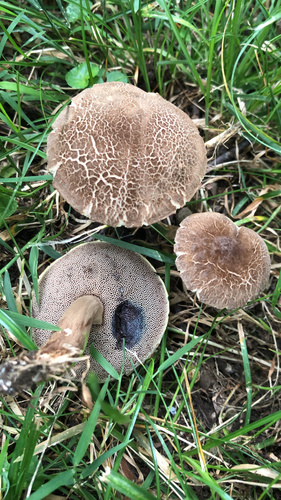
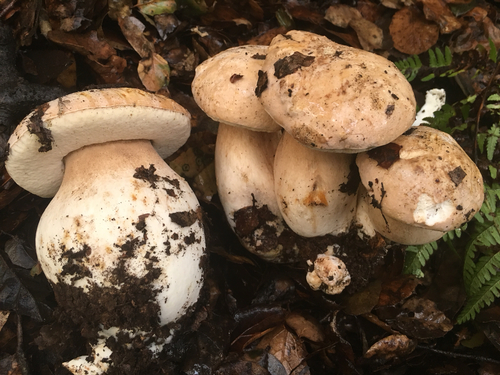
The cap of Boletus barrowsii Thiers & A.H.Sm. measures 5–25 centimetres (2–10 inches) in diameter. It starts out convex in shape before flattening, with a smooth or slightly woolly surface, and ranges in color from gray-white to white to buff. The thick flesh is white, and does not turn blue when bruised. The pores are initially whitish, turning yellow as the mushroom matures. The stout stipe is white with a brown net-like pattern, growing 6–20 cm (2+1⁄2–8 in) high, with an apical diameter of 2–6 cm (1–2 in). The spores are elliptical to spindle-shaped, with dimensions of 13–15 x 4–5 μm, and they produce an olive-brown spore print. Like B. edulis, Boletus barrowsii is often found infested and eaten by maggots. It develops a strong odor when drying. Boletus barrowsii, also known as the white king bolete, is ectomycorrhizal. In inland areas, it grows under Pinus ponderosa (ponderosa pine), and closer to the west coast it grows under Quercus agrifolia (coast live oak). Fruit bodies form after rain, and are more abundant when rain falls in early autumn, rather than later in the season from autumn through winter. It is abundant in the warmer regions of its range: Arizona and New Mexico. It also grows in Colorado, extending west into California and north to British Columbia. It has been recorded growing in the San Marcos Foothills in Santa Barbara County. The species is edible and considered a highly regarded edible mushroom in New Mexico, Arizona, and Colorado. For many years before it was formally described, it was eaten while misidentified as a form of B. edulis.