About Boletus aereus Bull.
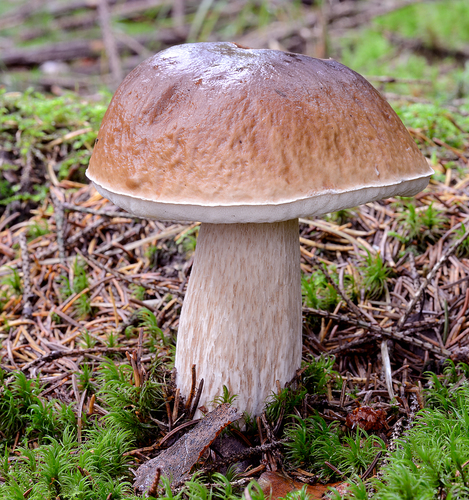
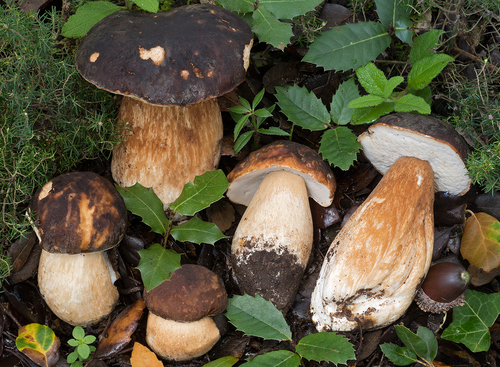
The cap of Boletus aereus Bull. ranges from hemispherical to convex, and reaches 15–20 cm (6–8 in) in diameter, though rare specimens can grow to 40 cm (16 in) across. The cap surface is slightly velvety; it is dark brown when young, and may mature to greyish-brown, violet brown, or purple brown, often with copper, golden, or olivaceous patches. The stipe is 5–15 cm (2–6 in) long and 2–5 cm (3⁄4–2 in) thick, and is usually shorter than the diameter of the cap. It is initially barrel-shaped, and gradually becomes club-shaped and tapers at the base. The stipe is white when young, then turns brown, chestnut, or reddish brown, and is covered in a brown or concolorous reticulation. Like other boletes, Boletus aereus has tubes rather than gills on the underside of the cap. The openings of the tubes, called pores, are small and rounded. They are whitish when young, slowly turn yellowish or greenish yellow as the mushroom matures, and may turn wine-colored when bruised. The tubes themselves start white, then become yellowish or olivaceous as they age. The thick flesh is white, has a strong, pleasant scent reminiscent of hazelnuts, and a mild sweet taste. Spores of Boletus aereus are spindle-shaped and measure 10.5–19 by 4–7 μm. The pileipellis is a trichodermium of interwoven septate hyphae, with long cylindrical cells.
The distribution and abundance of Boletus aereus varies widely across its range. It occurs mainly in central and southern Europe and north Africa, and is rare in colder climates such as England. It is classified as a vulnerable species in the Czech Republic, and has been added to the provisional Red List of endangered species of Montenegro. Despite this, the fungus can be locally abundant: it is the most common bolete in the woodlands of Madonie Regional Natural Park in northern Sicily, and has been recorded in several other Mediterranean island ecosystems including Corsica, Cyprus, Lesvos, and Naxos. Mushrooms of this species grow mostly during hot spells in summer and autumn. They form mycorrhizal associations with various broad-leaved trees and sclerophyllous shrubs, especially oak (Quercus), beech (Fagus), chestnut (Castanea), strawberry trees (Arbutus), treeheath (Erica), and rockrose (Cistus), and prefer acidic soils. Common habitats include roadsides and parks. Cork oak in particular is an important symbiont, and the distribution of B. aereus matches that of cork oak across Europe and North Africa. The ectomycorrhizae B. aereus forms with sweet chestnut (Castanea sativa) and downy oak (Quercus pubescens) have been described in detail: they lack hyphal clamps, have a plectenchymatous mantle made of parallel-orientated hyphae with little branching or overlap, and have rhizomorphs with differentiated hyphae. A 2007 field study of four bolete species found little correlation between the abundance of above-ground fruit bodies and the presence of mycelia below ground, even when soil samples were collected directly beneath the mushroom. The study concluded that the triggers for mycorrhiza formation and fruit body production are more complex than previously understood. While this fungus was historically reported to grow in China, recent molecular studies show that Asian porcini belong to separate species.
Boletus aereus is a choice edible species, and is highly valued in Southern Europe for its culinary qualities. Many people consider it gastronomically superior to Boletus edulis. Near Borgotaro, in the Province of Parma, northern Italy, four species—B. edulis, B. aereus, B. reticulatus (formerly known as B. aestivalis), and B. pinophilus—are recognized for their excellent taste and officially designated Fungo di Borgotaro. These mushrooms have been collected and exported commercially from this area for centuries. Across Spain, it is one of the most commonly collected wild edible fungi for home use, particularly in Aragon, where it is harvested for sale in markets. It is also popular in Spain's Navarre and Basque Country, as well as in France and Greece. When collecting this mushroom, the cap skin is left intact, and dirt is brushed off the surface. Pores are left on unless they are old and soft. Boletus aereus is particularly suited to drying, a process that improves its flavour and aroma. Like other boletes, the mushrooms can be dried by slicing them, stringing each slice separately on twine, and hanging the strands near a kitchen ceiling. Alternatively, after cleaning with a brush (washing is not recommended), the mushrooms can be placed in a wicker basket or bamboo steamer on top of a boiler or hot water tank to dry. Once dried, they are stored in an airtight jar. They are easily reconstituted by soaking in hot (not boiling) water for around twenty minutes; the resulting water is infused with mushroom aroma and can be used as stock for cooking. A small amount of dried Boletus aereus can improve the flavor of otherwise mild mushroom dishes.