About Boletinellus merulioides (Schwein.) Murrill
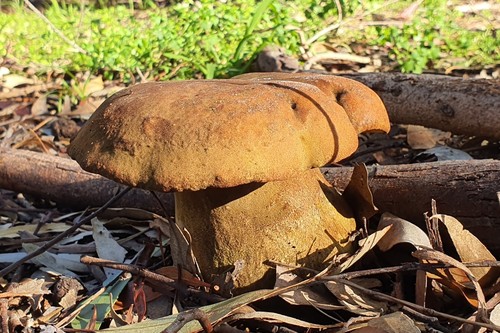
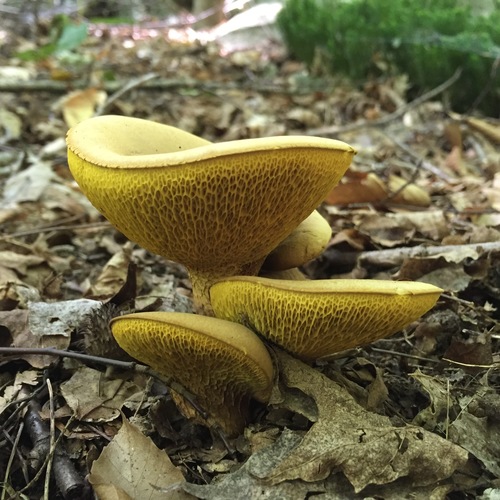
The cap of Boletinellus merulioides starts convex, then becomes flattened to convex when mature, reaching a diameter of 3.5–12 cm (1+1⁄2–4+3⁄4 inches). The cap surface is dry to slightly sticky, and either smooth or covered in tiny fibrils. Its color varies from yellow-brown to reddish-brown, and bruised areas turn dull yellow-brown. The stem grows up to 4 cm long, is often curved, and tapers starting from the cap. The flesh is yellow; when cut, it either does not change color or slowly turns blue-green. It has no distinctive odor. The pore surface is pale yellow to dull gold or olive, and slowly turns blue then reddish-brown when injured. The pores are boletinoid, meaning their structure is intermediate between gills and pores. They are around 1 mm wide, and the tube layer is 3–6 mm (1⁄8–1⁄4 inch) deep. The spore print is olive-brown. Unusual for boletes, this species forms abundant sclerotia. These are spherical to roughly elliptical structures 2–3 mm wide, with a hard, black to dark brown outer rind and a hollow internal medulla. Sclerotia occur singly or in clumps of more than 100, and are typically found between the mineral and organic layers of soil. The sclerotia let the fungus survive harsh conditions such as low temperatures, and let it rapidly colonize nearby soil when conditions become favorable. This fungus is found in eastern North America, ranging from eastern Canada south to Alabama and west to Wisconsin. It is also found in Mexico, and has been reported in Japan. It is a common species that produces fruit bodies in summer and autumn. Fruit bodies grow on the ground scattered or in groups, almost always near ash trees (Fraxinus spp.), and only rarely near maple and white pine. Boletinellus merulioides has a mutualistic relationship with a parasitic aphid that only lives on ash trees. The aphid feeds on ash tree roots, and shelters inside the fungus's hollow soil sclerotia, or on sclerotia attached to the root system. The aphid secretes carbohydrates and other nutrients that benefit the fungus. The fruit bodies are edible but of low quality, with an acidic and unpleasant taste. The mushrooms can be used in mushroom dyeing to produce light brown or dark orangish brown colors, depending on the mordant used.