About Boletellus ananas (M.A.Curtis) Murrill
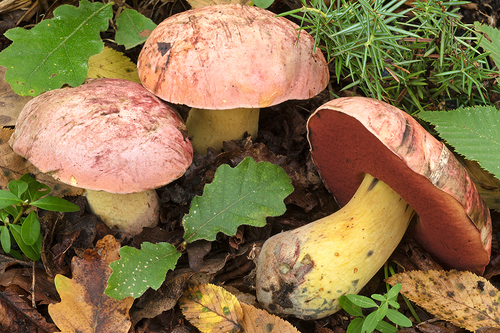
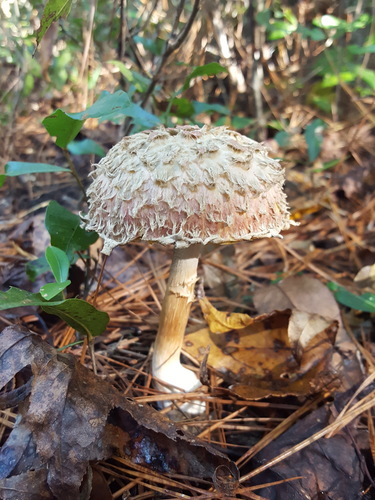
Boletellus ananas (M.A.Curtis) Murrill has a cap measuring 3.3–10 cm (1+1⁄4–4 in) wide with a plano-convex shape. Its surface is covered in small scales called squamules, which may lie pressed against the cap or curve backward. Squamule colors range from reddish brown to red-tan, pink, or pinkish gray, and they are more concentrated and scalier at the cap center, growing out of a cream to light orange-pink to light pink-red floccose background tissue. When young, the cap margin wraps around the stem; at maturity, it splits into triangular veil remnants called appendiculae that measure 6–12 by 3–10 mm, and these range in color from buff-white to faint pink. The cap flesh is 2–3 mm thick at the cap edge, 7–10 mm thick over the pores tubes, and 11–18 mm thick at the center. It is buff white to light yellow, and quickly turns blue when exposed to air. The tubes are 1–5 mm long at the cap margin, 10–20 mm long in the center, and 4–6 mm long at the stem attachment. They are broadly and deeply sunken around the stem, have irregular lengths, are colored bright yellow to olive-yellow to mustard-yellow, and also turn blue rapidly when exposed to air. The pores match the tube color, quickly turn blue-green when pressed, are angular in shape, and occur at a density of 0.5–1.5 pores per mm. The stem is 5–10 cm (2–4 in) tall and 6–14 mm (1⁄4–1⁄2 in) wide, and gradually widens toward its base to reach 10–19 mm there. The uppermost section of the stem is cream to pink, the middle section has fine longitudinal striations that darken when handled, are colored red-lavender to brown-red, and fade to a lighter shade with age. Just above the basal tomentum, the stem surface is cream-colored with very few striations. The basal tomentum covers the lower 6–50 mm of the stem, and consists of stiff, coarse white hairs. The stem flesh is solid (not hollow), colored white to buff-tan to light yellow, and turns slightly blue when exposed to air. B. ananas has no distinctive odor, though it has occasionally been described as "musty", and its taste is mild.
Microscopically, spore deposits from this species are olivaceous-brown in medium to heavy spore deposits. Spores are inamyloid, almond-shaped, contain one or more oil droplets, and measure 17.5–22.2 by 6.4–8 μm. The spore wall is 0.5–1 μm thick, marked with 12–14 longitudinal ridges. These ridges are less than 1 μm tall, occasionally split into two branches, converge at the spore poles, and have minute cross-striae. While these cross-striae are visible when observed with light microscopy, they are not visible when viewed with scanning electron microscopy. The hilar appendage, the region that attaches the spore to the basidium via the sterigma, is 0.3–1 μm long. Basidia are four-spored, club-shaped, hold numerous refractive globules, and measure 39–57 by 11–15 μm. Pleurocystidia, cystidia on the tube face, measure 42–47 by 8-12 μm, are swollen and beaked, and slightly capitate. They are abundant, grow from the subhymenium, project 19.3–29.6 μm above the hymenial palisade, have thin walls, are hyaline, and do not contain refractive contents. Cheilocystidia, cystidia on the tube edge, measure 19–42 by 5–11 μm, are swollen, cylindrical to narrowly cub-shaped, have thin walls, and are infrequent. The hymenial flesh is boletoid and strongly divergent, made up of different tissue layers. The mediostratum, the middle tissue layer, is 24.7–45.7 μm wide, and composed of many parallel, slightly interwoven hyphae. Lateral stratum hyphae are 4.4–8.4 μm wide, hyaline, become gelatinized in dilute potassium hydroxide (KOH) solution, and are regularly septate. The cap cuticle is a densely interwoven trichodermial palisade, an arrangement of erect, roughly parallel chains of closely packed cells, made of cylindrical elements with inflated terminal cells. The terminal cells measure 23.5–51.9 by 9.4–16.8 μm, are inamyloid, cylindrical to club-shaped, interwoven, and concentrated in the cap squamules. The marginal appendiculae are made of wefts of interwoven inflated hyphae, some of which have faint golden spirally arranged encrusting pigments that are visible when mounted in water, KOH, and Melzer's reagent. Cap flesh is made of highly interwoven hyphae 7.4–11.1 μm wide that are hyaline in water, gelatinized and hyaline in KOH, and regularly septate. The stipitipellis, the stem cuticle, is a trichodermial palisade of cylindrical elements with inflated terminal cells. The terminal cells project 30.4–63 μm, are cylindrical to club-shaped, and occasionally end in an abrupt tapering point. Stem flesh is made of densely interwoven hyphae 4.9–7.2 μm wide, with spirally arranged, faint golden encrusting pigments that are visible in KOH, Melzer's reagent, and water. Clamp connections are absent in this species.
Fruit bodies of B. ananas typically grow scattered or in groups under oak and pine trees, often at their bases. In Guyana, this mushroom usually fruits singly or in pairs 1–2 m (3+1⁄2–6+1⁄2 ft) above ground level on trunks of the tropical tree Dicymbe corymbosa (subfamily Caesalpinioideae), associated with ectomycorrhizas within accumulated humus. It is rarely found fruiting on the ground on heavily decayed, root-penetrated wood. Rolf Singer suggested the fungus was not mycorrhizal, noting that in addition to occurring under or at the bases of pine and oak, it also grows in small amounts of humus and debris accumulated on rock walls. Singer concluded the species prefers to grow on hard surfaces. In his study of Texas bolete flora, Harry D. Thiers wrote that B. ananas is a rare species that often fruits abundantly after an extended period of rain and high humidity. Some populations of B. ananas from southeastern North America, Costa Rica, Brazil, Panama, Nicaragua, and Guyana have been recorded fruiting on tree trunks, while terrestrial fruiting has been reported in Malaysia and Central America. B. ananas' ectomycorrhizal status has been debated due to its typically elevated fruiting habit and occurrence on dead wood; in the original description, Murrill noted "it always occurs either as a wound parasite on pine trunks or about the base of living pine trees". All collections have been made in association with ectotrophic host trees: Pinus and Quercus species in southeastern North America and Central America, Quercus humboldtii in Colombia, various Fagaceae and Dipterocarpaceae species in Malaysia, and Leptospermum and Pinus species in New Zealand. In Guyana, humic deposits on Dicymbe trunks holding B. ananas are consistently permeated with abundant ectomycorrhizas. The fungus has been reported to form mycorrhizal associations with eucalypts in Australia, based on the association of fruit bodies with these trees. In North America, its distribution extends north from North Carolina to Florida, west to Texas, and south to Mexico and Central America, and it fruits from June to October. In 2008, it was reported for the first time in the Upper Potaro and Upper Ireng River Basins in Guyana. It has also been collected from New Zealand, Asia (including China, Korea, Malaysia, and Taiwan), and possibly Australia.