About Bolbopsittacus lunulatus (Scopoli, 1786)
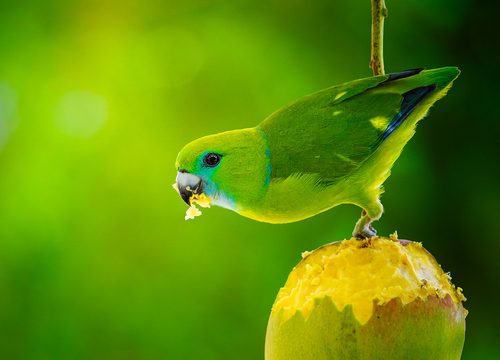
Bolbopsittacus lunulatus, commonly called the guaiabero, was first described as Psittacus lunulatus by Tyrolean naturalist Giovanni Antonio Scopoli in 1786. It is the only member of its genus and considered a distinctive species. Measuring around 15 cm (5.9 in) in length, it is a smallish, stout parrot with a large bill and stubby tail. The sexes differ in plumage. The adult male is green overall, with more yellowish underparts, a pale blue face, pale blue collar, and pale blue wing primaries. Its rump is yellow-green, its bill is grey-blue with a darker tip, and its eyes are dark brown. The adult female is also greenish, with a yellow collar and less blue on the face. It has black crescent markings on the nape and rump, and its bill is paler grey. This species lives in primary or secondary forests, mangroves, and plantations with available termite mounds, up to 1,000 meters above sea level. It primarily inhabits lowland forests and adjacent cleared areas. The IUCN Red List has assessed this bird as a least-concern species, as it is common throughout its range and found across the entire Philippines. Its population remains stable, and it appears to be tolerant of degraded habitat. However, this species is trapped for the pet trade, even though it has relatively low survivability compared to other parrots. It is a predominantly fruit-eating parrot, and has been recorded near fruit trees such as mangos. Its common name comes from its affinity for guava trees. It has also been recorded feeding on seeds. Its wild breeding habits were almost entirely unknown until recent years; based on recent observations, it appears to nest in a self-excavated cavity inside an arboreal ant nest or termitaria.