About Bolbometopon muricatum (Valenciennes, 1840)
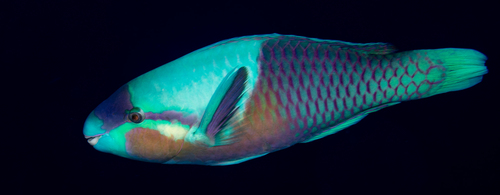
Bolbometopon muricatum differs from typical wrasses by its vertical head profile, and differs from other parrotfishes by being uniformly covered in scales except for the leading edge of its head, which is often light green to pink. The primary phase of this species has dull gray coloration with scattered white spots, and this coloration gradually changes to a uniform dark green. Unlike the common pattern in the wrasse family Labridae, this species does not show sex-associated color change. Adult individuals develop a bulbous forehead that is sometimes described as an "ossified ridge", and their tooth plates are exposed, only partly covered by lips. This species is gregarious and typically forms small schools, but can form quite large groups exceeding 75 individuals on seaward reefs and clear outer lagoon reefs. Records from the 1970s note even larger schools that can reach up to 250 individual fish. The green humphead parrotfish is slow-growing and long-lived, reaching up to 40 years of age. It has delayed reproduction and low replenishment rates. This species is sexually monochromatic, meaning adult life cycles do not have distinct initial or terminal phases. It spawns pelagically near outer reef slopes, promontories, gutters, or channel mouths, following a lunar cycle and usually spawning just before the new moon. The species uses specific spawning aggregation sites. Newly settled juveniles live in branching coral habitats, primarily Acropora, in sheltered lagoons. Small juveniles under 50mm are often associated with damselfish. Larger juveniles are found in lagoons, frequently in seagrass beds. Adults live in clear outer lagoons and seaward reefs at depths up to 30 m (98 ft).