About Boissonneaua matthewsii (Bourcier, 1847)
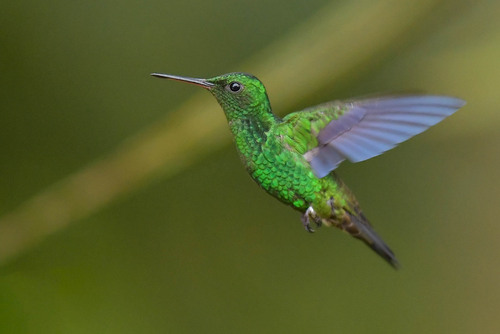
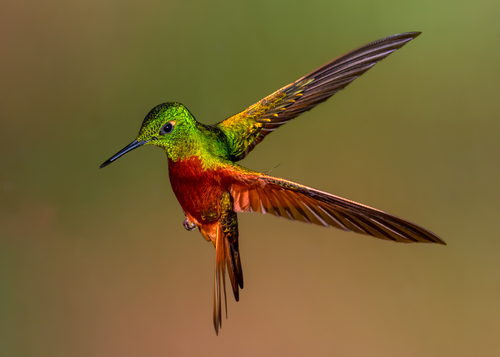
The chestnut-breasted coronet (scientific name Boissonneaua matthewsii (Bourcier, 1847)) is 10.5 to 13 cm (4.1 to 5.1 in) long and weighs approximately 6.5 to 8.3 g (0.23 to 0.29 oz). Both male and female individuals have a short, straight, black bill, a white spot behind the eye, and a notched tail. Males have metallic green upperparts. Their throat has yellowish green speckles over a buff base, and the rest of their underparts are reddish chestnut with some green speckles on the flanks. The central tail feathers of males are bronzy, and the remaining tail feathers are reddish chestnut with bronzy tips. Female plumage is almost identical to that of males, but females have somewhat paler underparts and less speckling on the throat. The chestnut-breasted coronet is distributed from extreme southeastern Colombia, extending south along the east slope of the Andes through Ecuador and Peru to Cuzco Department. It is also found on the west slope of the Andes from central Ecuador into northwestern Peru. This species inhabits the interior and edges of humid montane forest, and also occurs in gardens near forested areas. In Ecuador, it occurs at elevations between 1,600 and 3,300 m (5,200 and 10,800 ft), and is most numerous between 1,900 and 2,700 m (6,200 and 8,900 ft). In Peru, it occurs between 1,500 and 3,300 m (4,900 and 10,800 ft).