About Boissonneaua flavescens (Loddiges, 1832)
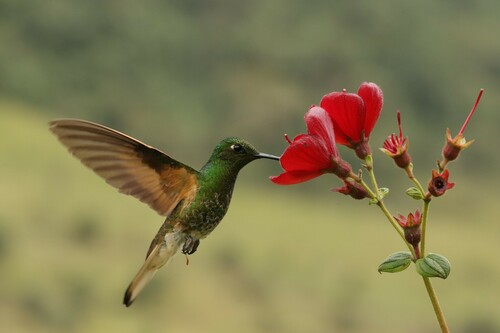
The buff-tailed coronet (Boissonneaua flavescens (Loddiges, 1832)) is 11 to 12 cm (4.3 to 4.7 in) long and weighs 7.3 to 8.8 g (0.26 to 0.31 oz). Both sexes have a short, straight, black bill and a small white spot behind the eye, as well as small white tufts on the legs. Males of the nominate subspecies are mostly shining green, with a buff belly marked by green spots. Their underwing coverts are cinnamon, and are visible when the bird is in flight. Their central tail feathers are bronzy, while the rest are buff with bronze tips and edges. The nominate female has more buff on its underparts, and the bronze coloring on its tail is less extensive. For the subspecies B. f. tinochlora, the buff-colored body parts of both sexes have a cinnamon tint, and there is more bronze on the tips of the tail feathers. The nominate subspecies is distributed from the Andes of western Venezuela's Mérida state south and west through all three Andean ranges of Colombia. B. f. tinochlora is found from southwestern Colombia south along the west slope of the Andes as far as Cotopaxi Province in central Ecuador, and also occurs in a few locations on Ecuador's eastern Andean slope. This species lives in the interior and edges of humid to wet montane forest, cloudforest, and elfin forest, and can also be found in more open shrubby landscapes. Its elevational range is 2,000 to 3,500 m (6,600 to 11,500 ft).