About Bohadschia argus Jaeger, 1833
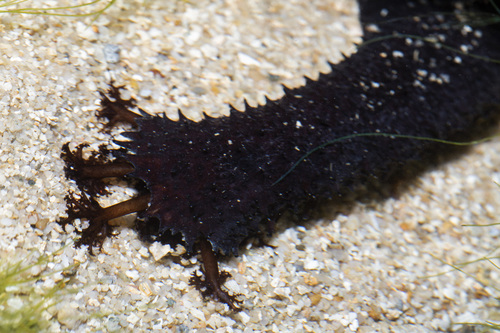
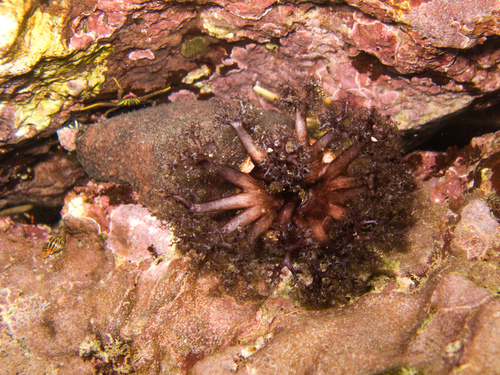
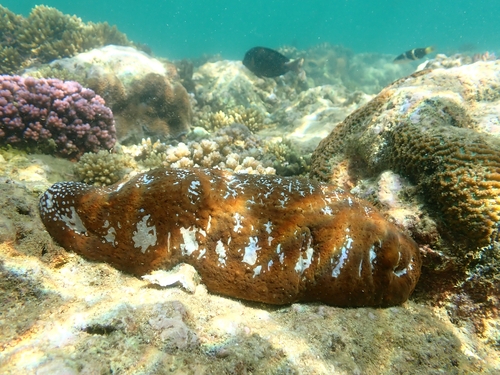
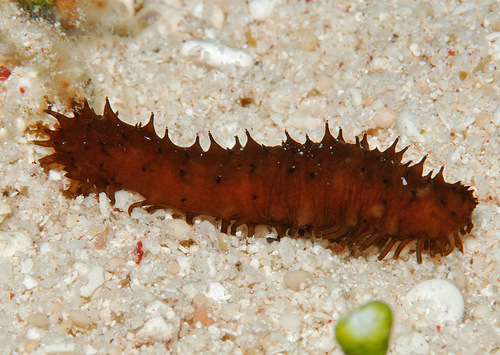
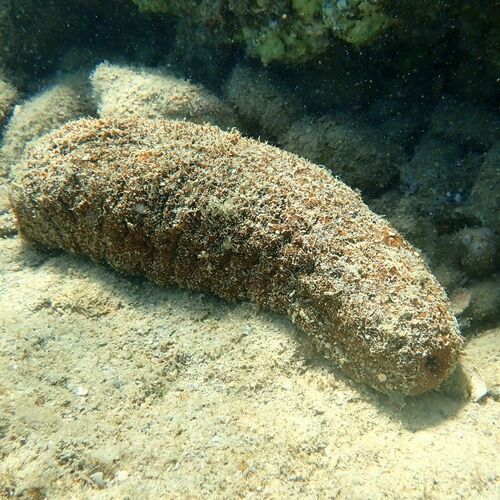
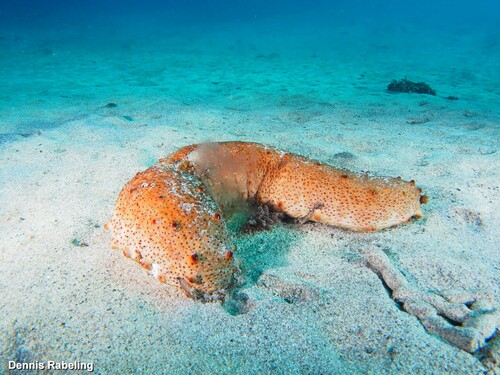
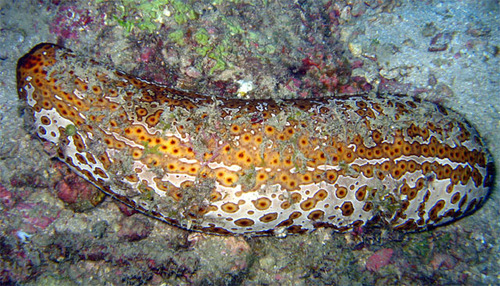
Bohadschia argus shares the roughly cylindrical body plan common to most sea cucumbers. On average, this species reaches around 36 cm (14 in) in length and weighs 1.8 to 2.2 kg (4.0 to 4.9 lb), with a maximum recorded length of 60 cm (24 in). Its tough outer body wall is about 10 mm (0.39 in) thick, with a firm, leathery texture. The dorsal side is greyish-brown, covered in numerous yellow eyespots that match the pattern referenced in its common name. The underside is usually paler, though some specimens are uniformly brown across their entire body. Several rows of tube feet run along the underside, which the animal uses for locomotion. At the anterior end, a ring of paddle-shaped black feeding tentacles with white fringes surrounds the mouth. At the posterior end, Cuvierian tubules sit at the base of the anus. If the animal is disturbed or handled, it readily ejects these tubules as sticky threads. The threads contain toxins that deter predators and cause irritation to human skin. Bohadschia argus is known to be able to hybridize with Bohadschia vitiensis. This species inhabits shallow tropical waters across the eastern Indian Ocean and western Pacific. It is commonly found in and around coral reefs, on exposed sandy areas of the seabed, most often at depths of 2 to 10 m (6.6 to 32.8 ft) below the surface. Bohadschia argus is a detritivore. As it moves across the seabed, it uses its sticky tentacles to sweep sand grains and detritus into its mouth, and gains nourishment from the biofilm coating the sand grains. A new triterpene glycoside called Arguside A has been extracted from the tissues of Bohadschia argus, and this compound shows cytotoxic activity against several types of human tumor cells.