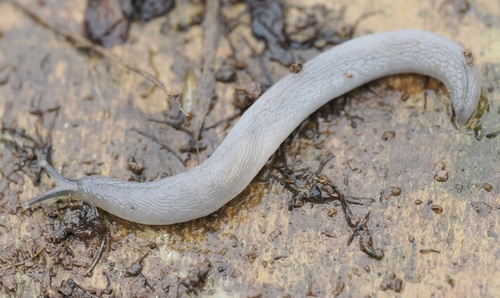
About Boettgerilla pallens Simroth, 1912
Boettgerilla pallens Simroth, 1912 is a very narrow, slender slug with an almost worm-like body and a sharply keeled back. Its base color is pale grey, sometimes with a bluish tint; the head and keel are slightly darker. The mantle is pointed at its posterior end and marked with fine concentric grooves. The sole is pale yellow, and the mucus is colorless. Juveniles range from yellowish to dirty white. Fully grown individuals reach a maximum body length of 60 mm and maximum width of 3 mm. The internal shell of this species is small and fragile, measuring 1.5–3 mm long by 0.8–1.5 mm wide. It has a median nucleus and visible growth lines that are denser in its posterior portion; it lacks a thin margin, and sits beneath the very tip of the pointed posterior end of the mantle. In its reproductive system, the penis is elongated and wider than the vagina, epiphallus, and spermatheca. The epiphallus is swollen, and connects to the lateral side of the penis near its posterior end via a long, thin duct that is narrower than the vas deferens. The vagina is the same length as the penis, and almost as narrow as the vas deferens. No accessory glands are present. The spermatheca is elongated and relatively short. This species is far more slender than Milax gagates, and also has a more slender sole. Milax gagates differs further in having a rounded posterior end to the mantle, a larger, more easily visible shell, and a yellowish-brown body color. The type locality of Boettgerilla pallens is Gudauta, Abkhazia. Its native range is thought to be the southwestern flank of the Caucasus, covering Abkhazia and western Georgia; it may also be native to Armenia, the Crimean Mountains, and the Donetsk Upland in Ukraine. Over the last half century, the species has spread dramatically across new regions. Dates of first regional records are published in Reise et al. (2000). In Europe, Boettgerilla pallens was first recorded outside its native range in 1949, in Germany. It is now naturalized across most of Europe, though it has not been reported from most of Spain, Italy, and the Balkan Peninsula. Confirmed European occurrences include Ireland (recorded since 1973), Great Britain (since 1972), France, Belgium, Netherlands, Germany, Switzerland, Austria, Czech Republic, Slovakia, Poland (since 1954, mainly in southwestern Poland), Finland, Sweden, Lithuania, Russia (Moscow, Saint Petersburg, and other cities), northern Spain, Andorra, northern Italy, Romania, Slovenia (since 1994), Serbia (since 2022), Bulgaria (since 1999), Ukraine (Kyiv, Lviv, Ivano-Frankivsk, Vinnytsia, multiple cities in Crimea, and other locations), and Iceland. Outside Europe, Boettgerilla pallens is considered an introduced species in Western Siberia (Russia), Tajikistan, Turkey, the Canary Islands (Spain), Canada (British Columbia, Newfoundland, Quebec), the United States (California, Oregon), Mexico, and Colombia. Reise et al. (2000) reviewed this species' distribution, range expansion patterns, and other ecological traits. Boettgerilla pallens occupies a very wide range of habitats, including gardens, grassland, coniferous woodland, and deciduous woodland. It tolerates a broad range of soil pH, calcium content, and water content. It occurs at altitudes up to 1750 m in the Caucasus and up to 1600 m in Switzerland, but is usually found below 700 m. It can be classified as synanthropic, but is now also frequently found in undisturbed habitats. While it may be found under logs and stones, Boettgerilla pallens is predominantly subterranean, adapted to moving through earthworm burrows and similar small voids in soil between 2 and 20 cm below the surface (with records of individuals as deep as 60 cm). These slugs move rapidly away from bright light. Their feeding is seldom intensive: they typically take only a few bites of food (including earthworm faeces, detritus, and arionid eggs) before moving on. Though often found in gardens and greenhouses, it has only rarely been considered a pest. One study recorded the species coming to the surface at night to prey on snails. In Britain, mating and egg-laying occur in late summer through autumn; in Germany, this activity takes place through October. Eggs are laid 9–27 cm below the surface, in multiple clutches each holding 1 to 6 eggs. Adults survive egg-laying but die shortly after. At a temperature of 17 °C in Germany, juveniles hatch after 20 to 22 days; in Britain, hatching occurs between October and December. Juveniles change color from white to grey between May and June.

