About Bodianus diplotaenia (Gill, 1862)
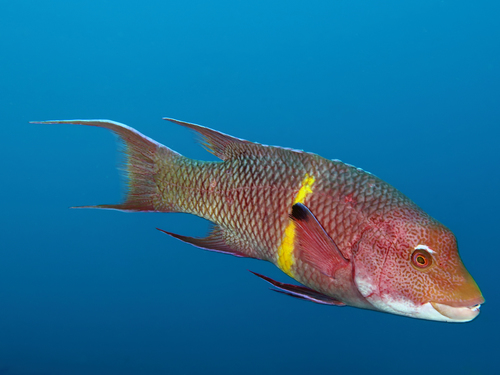
Bodianus diplotaenia, commonly known as the Mexican hogfish, has a robust, compressed body. Large males develop a distinct hump between their eyes, and the species has a pointed snout. Dentition includes one canine tooth at the rear of the upper jaw, plus two pairs of strong canines at the front of both the upper and lower jaws. This species has 10 dorsal fins and 12 anal fins. Adult males have long filaments on the lobes of their tail fin, as well as extended posterior rays on the dorsal and anal fins. There are 17 pectoral rays, an unbroken, smoothly arched lateral line, and 31 large pore-bearing scales along the lateral line. Mexican hogfish reach a maximum total length of 76 cm, and most commonly grow up to 35 cm. Coloration varies by life phase. In the initial phase, individuals are reddish, fading to yellow on the posterior body and caudal fin. They have a pair of blackish stripes, which may be broken, across the upper half of their side, and individual scale margins range from brown to reddish. In the terminal phase, individuals are bluish green with a brown head (with the exception of a white lower jaw) and a narrow yellowish bar along the middle of the side. Juveniles resemble initial phase adults, but have a yellow base body color. This species is distributed in the eastern Pacific Ocean, ranging from Guadalupe Island and the entire Gulf of California south to Chile. Its distribution also includes the Cocos, Malpelo, Revillagigedo, and Galapagos islands.