About Bodianus axillaris (Bennett, 1832)
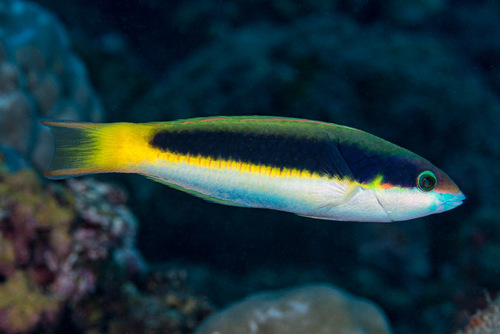
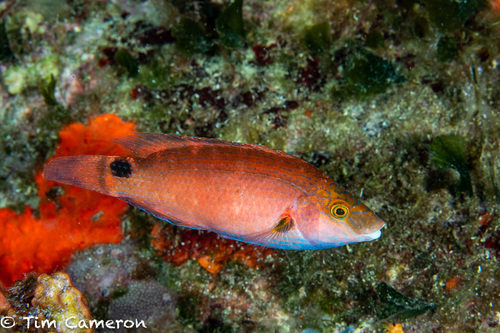
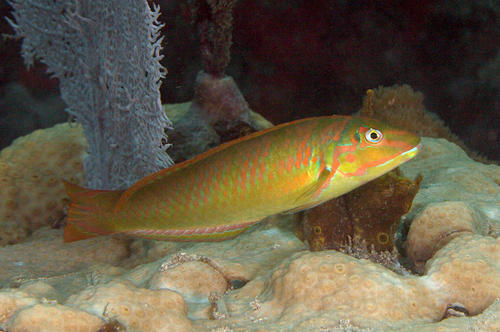
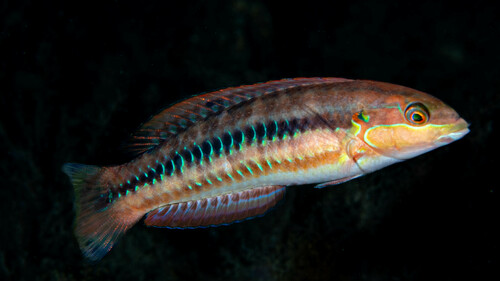
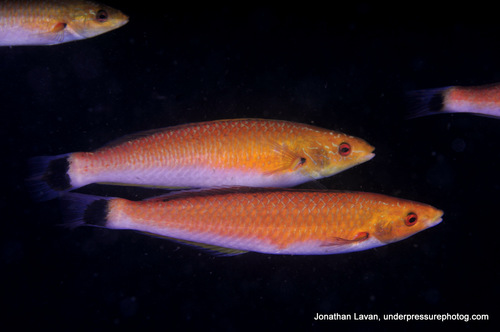
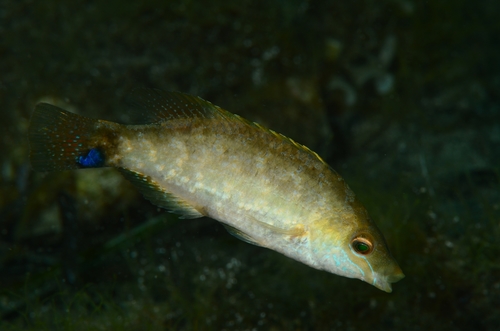
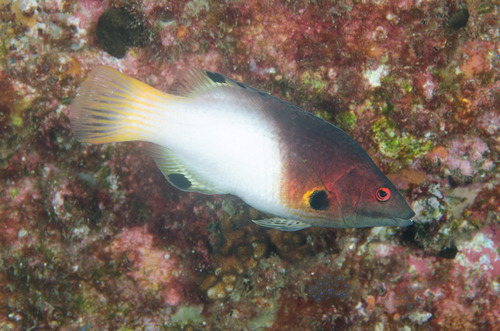
Bodianus axillaris, commonly called the axilspot hogfish, is sexually dimorphic. Adult males have a reddish-brown color on the front half of their bodies, which contrasts with a white posterior end, and they have a large black spot at the base of the pectoral fin, as well as on the dorsal and anal fins. Females and juvenile axilspot hogfish are blackish, marked with white blotches along the upper and lower flanks. Juveniles of this species look similar to juveniles of the split-level hogfish, Bodianus mesothorax, but they have white spots instead of yellow spots. This species reaches a maximum standard length of 20 centimetres (7.9 in).
The axilspot hogfish was formally described by English zoologist Edward Turner Bennett in 1832, originally named Labrus axillaris, with its type locality recorded as Mauritius.
It is distributed across the Indo-Pacific region, ranging from the Red Sea to South Africa, and east to the Marshall Islands, Marquesan Islands, and Tuamoto Islands, with its northern range extending to Japan.
Adult axilspot hogfish live in clear lagoons and along seaward reefs; they are common in clear shallow water at depths between 1 and 8 metres (3.3 and 26.2 ft). Larger individuals are occasionally found in deeper water below 27 metres (89 ft). Juveniles live alone in caves or under overhangs and act as cleaner fish, and adults will sometimes behave this way too. Their diet consists of benthic, hard-shelled invertebrates including molluscs and crustaceans. This species is oviparous, and males and females form distinct pairs for spawning.
The axilspot hogfish is rarely found in the aquarium trade, and it has no commercial interest to fisheries.