About Boana rosenbergi (Boulenger, 1898)
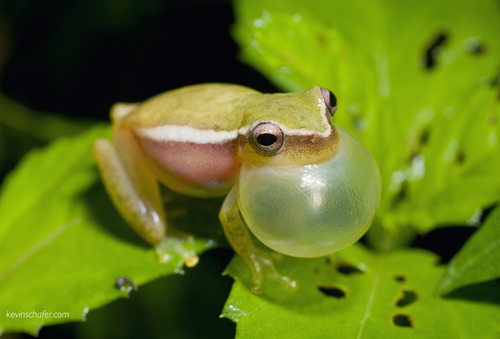
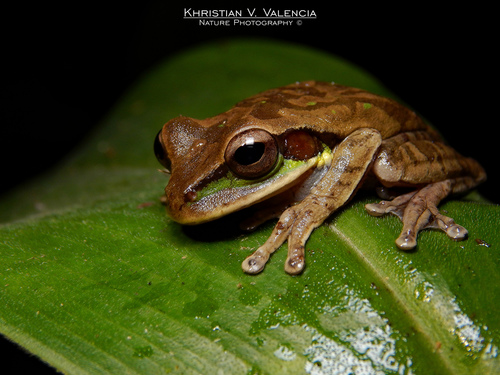
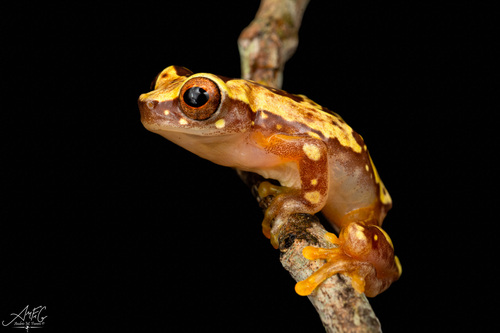
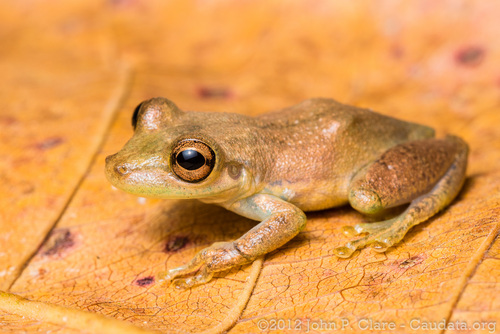
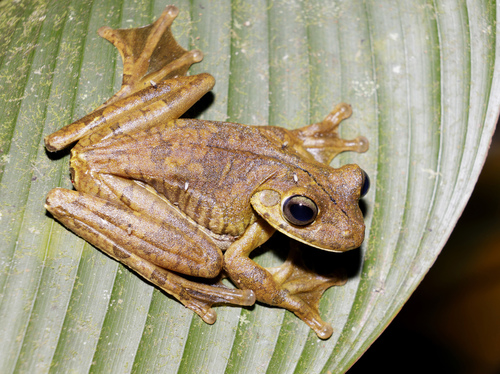
Boana rosenbergi (originally referenced as H. rosenbergi) shows size variation between different populations: individuals from the Costa Rican population are smaller than those from the Panamanian population. In the Panamanian population, males have an average snout–vent length of 83 mm (3.3 in), while females average 86 mm (3.4 in), and females are typically heavier than males. This species has partly webbed fingers, fully webbed toes, and large adhesive disks on both fingers and toes. Its skin is granulated with small warts, and is colored yellowish, greyish, or reddish, with brown or blackish marbling or spots. It has dark worm-like markings across the dorsal surfaces of its body and limbs, gray-white undersurfaces, and a pigmented area near the throat. Males usually have more heavily pigmented throats than females, a trait likely controlled by hormones, as more pigmented individuals call more frequently. Females typically have more yellow coloration on their dorsal surfaces than males, and the female's body wall in front of the groin is nearly transparent, making her black eggs easily visible. The lower jaw is pale yellow with black worm-like markings matching those on the dorsal surface, and the iris of the eye is bronze or golden with black surrounding it. Most of this species' color fades to light gray or tan during the day, and most visible patterns also disappear. Males have prepollical spines on their hands: these are pointed, scythe-shaped spines used in combat, which gives the species its alternative common name, Rosenberg's gladiator frog. Females also have these spines, but they are very small. Only males can control the position of the spines and retract the fleshy sheath to expose the scythe-shaped parts for combat. Boana rosenbergi inhabits primary and secondary forest, as well as heavily altered areas such as narrow strips of trees in pastureland. It has been recorded from Costa Rica to Panama. It is not known whether the species has a continuous distribution across this range, or if the three recorded disjunct populations (in south-central Panama, across the Panamanian canal zone, extending from Colombia to Ecuador) reflect gaps in specimen collection. At its maximum extent, the distribution of Boana rosenbergi may stretch from central Panama to western Ecuador. It is sympatric with Boana boans and sometimes Boana pugnax, and co-occurs with both species in the headwaters of Rio Sinu and in Parque Nacional Natural de Katios in the northern Choco region of Colombia. Female Boana rosenbergi lay clutches approximately once every 25 days, with an average clutch size of around 2,000 eggs. The eggs have a dark animal pole and a yellow-white vegetal pole, surrounded by two clear capsules. They are laid singly on the water surface, where they spread out to form a monolayer. Offspring develop tail buds around 40 hours after fertilization; the tail buds grow rapidly until 150 hours after fertilization, after which their growth slows. Offspring begin hatching around 40 hours after fertilization, make first swimming movements around 85 hours after fertilization, and achieve active swimming by 140 hours after fertilization. Tadpoles have large filamentous gills. They undergo metamorphosis when they reach 21 mm in snout–vent length, approximately 40 days after fertilization. Newly metamorphosed froglets have extremely large fat bodies and visibly undifferentiated gonads. They are covered in many small dark spots, and have much less webbing on their fingers and toes than adult frogs. After metamorphosis, froglets leave the water. Individuals of this species can reach sexual maturity in one year. Reproduction in Boana rosenbergi is affected by both social and environmental factors. Female reproductive activity is moderated by the social cue of current chorus size, while male activity is affected by both same-day precipitation (heavy rainfall reduces activity) and previous day chorus size.