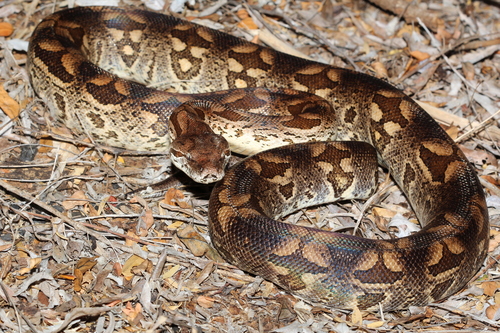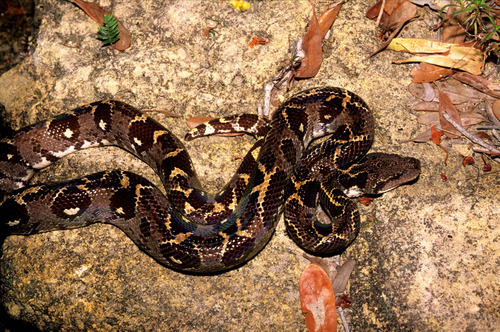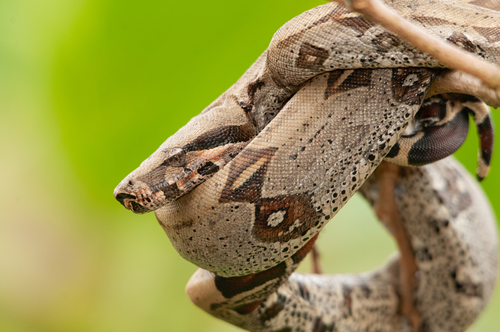
About Boa constrictor Linnaeus, 1758
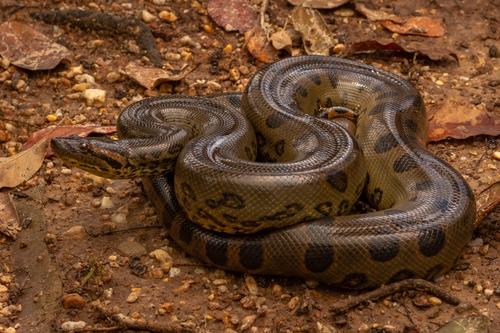
Boa constrictor, described by Linnaeus in 1758, is also called the common boa. It is a large, heavy-bodied, non-venomous snake species in the family Boidae, native to tropical South America. It is commonly kept and bred in captivity, and is a staple of both private reptile collections and public animal displays. Its color pattern is highly variable while still being distinctive, and four subspecies of Boa constrictor are currently recognized.
Depending on the subspecies, Boa constrictor can be found across all of South America north of 35°S, including in Colombia, Ecuador, Peru, Venezuela, Trinidad and Tobago, Guyana, Suriname, French Guiana, Brazil, Bolivia, Uruguay, and Argentina, plus many islands along the South American coast. Introduced populations have been recorded in Cozumel, extreme southern Florida, and St. Croix in the U.S. Virgin Islands. The species' original recorded type locality was given as "Indiis", which Peters and Orejas-Miranda identified as a mistake in 1970. Boa constrictor thrives in a wide range of environmental conditions, from tropical rainforests to arid semi-desert. It prefers rainforest habitat for the region's humidity and temperature, natural cover from predators, and abundant potential prey. It is often found in or alongside rivers and streams, as it is a very capable swimmer. Boa constrictors also use burrows dug by medium-sized mammals as shelter to hide from predators.
Boa constrictors are ovoviviparous, meaning they give birth to live young. They typically breed during the dry season between April and August, and have a polygynous mating system where individual males may mate with multiple females. In any given year, only half of all females will breed, while a larger share of males actively seek out mates. Many males do not successfully breed, due to this polygynous structure. Females in poor physical condition are unlikely to attempt to mate, or to produce viable offspring if they do mate. Reproduction in boa constrictors is almost exclusively sexual, though one individual was documented reproducing asexually via parthenogenesis in 2010.
Facultative parthenogenesis producing WW female offspring has been recorded in the related Colombian rainbow boa Epicrates maurus. These WW females are thought to come from terminal automixis, a form of parthenogenesis where two terminal haploid products of meiosis fuse to form a zygote that develops into female offspring. This 2010 observation in boas was only the third genetically confirmed case of consecutive virgin births of viable offspring from a single female in any vertebrate lineage. In 2017, researchers found that Boa constrictor, along with Boa imperator and Burmese pythons, have a novel system of sex-determining chromosomes: males carry a pair of XY sex-determining chromosomes, while females carry a XX pair. Before this discovery, snakes were not known to have male heterogamety; this trait has since also been identified in ball pythons Python regius.
During the breeding season, female boa constrictors release pheromones from their cloaca to attract males. Multiple males may wrestle to win the opportunity to breed with a single female. During copulation, the male curls his tail around the female's and inserts his hemipenes, the male reproductive organs. Copulation can last from a few minutes to several hours, and may happen multiple times over a period of a few weeks. Ovulation may not occur right after copulation, as females can store sperm inside their bodies for up to one year. When a female ovulates, she develops a midbody swell that looks similar to the swelling after eating a large meal. Two to three weeks after ovulation, the female undergoes a post-ovulation shed that lasts 2 to 3 weeks, longer than a typical shed.
Gestation is counted from the post-ovulation shed, and lasts approximately 100 to 120 days. After gestation, the female gives birth to live young that average 38 to 51 cm (15 to 20 inches) in length. Litter size varies between individuals, ranging from 10 to 65 young with an average of 25. Some offspring may be stillborn, or unfertilized eggs commonly called "slugs". Young boa constrictors are independent immediately at birth, and grow rapidly for their first few years, shedding every one to two months. They reach sexual maturity and their full adult size of 1.8 to 3.0 meters (6 to 10 feet) at 3 to 4 years old, though they continue growing at a slow rate for the rest of their lives. After reaching adulthood and sexual maturity, they shed less frequently, around every 2 to 4 months.